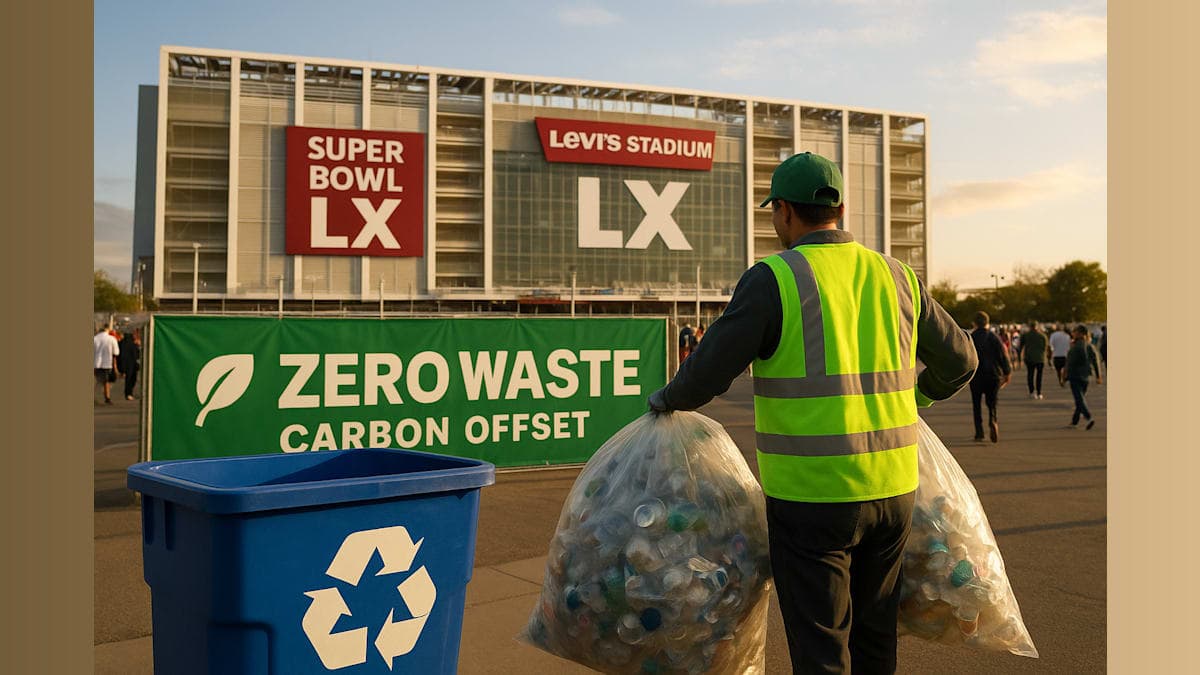
The National Football League has proven that environmental responsibility and championship-level entertainment need not be mutually exclusive. Super Bowl LX, held at Levi's Stadium in Santa Clara, California, achieved remarkable sustainability benchmarks through a comprehensive partnership with ENGIE Impact, a sustainable resource management company.
The environmental initiative represents a significant evolution in how major sporting events approach their ecological footprint. Building upon lessons learned from the previous Super Bowl in New Orleans, the NFL and its partners implemented an extensive waste management and carbon offset program that transformed the event into a model of responsible event planning.
Unprecedented Material Recovery
The waste diversion program achieved extraordinary results, recovering 250 tons of materials during the New Orleans event—a five-fold increase compared to the preceding Super Bowl. This massive recovery effort encompassed traditional recyclables as well as innovative repurposing of event-specific materials that would typically end up in landfills.
Ryan Schlar, Director of Sustainable Mobile Operations at ENGIE, outlined the creative approaches employed to maximize material reuse. Fence mesh that lined the stadium perimeter was donated to parks and recreation departments. Carpeting from tailgate party areas found new life in local schools, where it was repurposed as classroom carpet squares. Even wayfinding signage with unmarked reverse sides was distributed to artists, providing canvases for future creative projects.
Schlar emphasized the community-focused nature of these donation programs, stating that organizers prioritize organizations capable of delivering substantial communal benefits. The approach varies by location, with donation strategies tailored to address specific needs within each host community.
Infrastructure Advantages at Levi's Stadium
Levi's Stadium provided significant advantages for achieving sustainability goals. The facility operates almost entirely on solar power, substantially reducing the carbon footprint associated with the event. The stadium complex features a three-color waste bin system throughout, designed to facilitate proper sorting of recyclables, compostables, and landfill waste.
ENGIE deployed specialized staff members throughout the venue to assist attendees with proper waste disposal, ensuring that materials were correctly sorted and maximizing diversion rates. Where diesel generators were necessary for climate control systems, the operation utilized biodiesel fuel, which produces lower emission rates compared to conventional diesel.
Certain infrastructure elements installed for the Super Bowl will remain in place to support future events, including the FIFA World Cup scheduled for the summer. This forward-thinking approach reduces waste while providing lasting value to the facility and future event organizers.
Carbon Neutrality Through Strategic Offsets
Beyond waste management, the NFL invested in carbon offset programs to neutralize emissions generated by the event. During the New Orleans Super Bowl, the league purchased offsets for approximately 3,000 tons of carbon dioxide. These offsets support various environmental initiatives, including reforestation projects and direct-air capture facilities that remove carbon dioxide from the atmosphere.
Given Levi's Stadium's substantial solar power infrastructure, the Santa Clara event may have achieved net-negative carbon emissions—meaning the offsets purchased potentially exceeded the actual emissions generated. While precise figures for this year's event remain under analysis, preliminary assessments indicate comparable success to the New Orleans achievements.
Evolving Standards for Major Events
Schlar noted that success metrics evolve with each event, as organizers establish benchmarks based on each stadium's existing sustainability infrastructure. This adaptive approach acknowledges that different venues present unique challenges and opportunities, requiring customized strategies rather than one-size-fits-all solutions.
The NFL's commitment to sustainable event management extends beyond a single championship game. The organization has demonstrated that even events drawing tens of thousands of attendees and generating massive media attention can operate responsibly when proper planning, partnerships, and infrastructure align.
As major sporting events face increasing scrutiny regarding their environmental impact, the Super Bowl sustainability program offers a blueprint for responsible event management. The initiative proves that environmental stewardship and world-class entertainment can coexist, setting new expectations for how large-scale events should operate in an era of climate awareness.