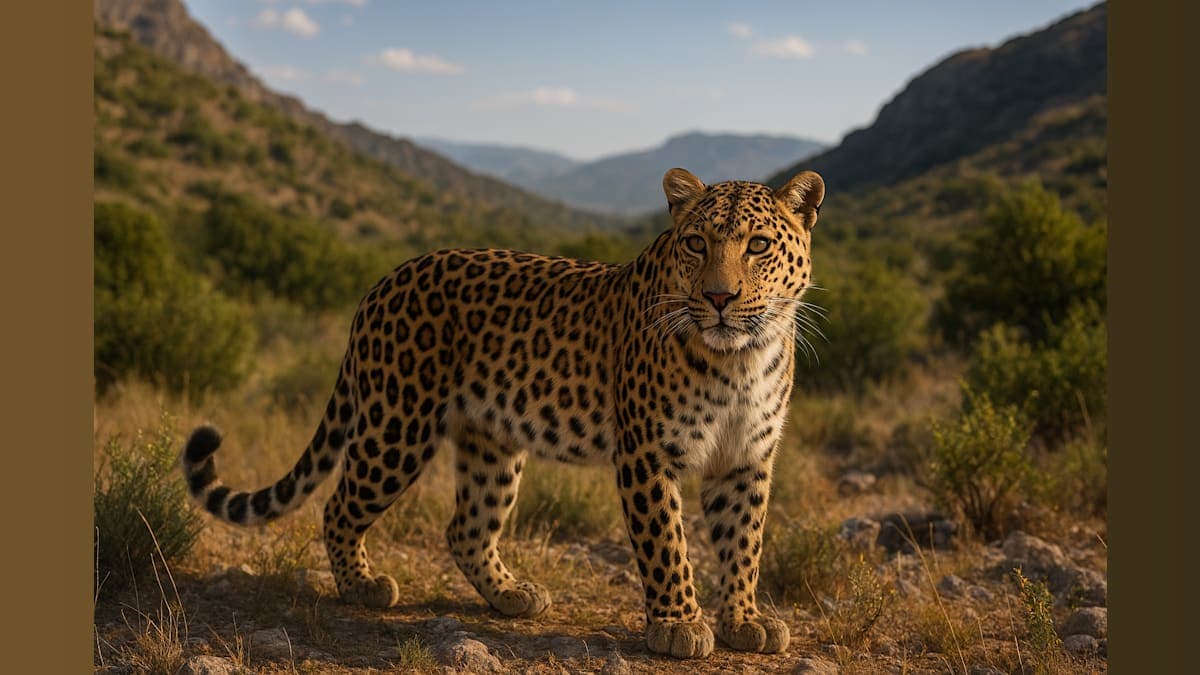
A comprehensive wildlife monitoring initiative in western Turkmenistan has revealed promising evidence of population growth among Persian leopards, one of the world's most endangered big cat subspecies. The survey, conducted through an extensive network of camera traps, indicates that between 60 and 80 of these majestic predators now inhabit the nation's protected reserves, marking a notable increase from previous assessments.
The Persian leopard, scientifically designated as Panthera pardus tulliana and alternatively known as the Anatolian or Caucasian leopard, represents one of the largest-bodied leopard populations globally. With an estimated total population of approximately 1,000 individuals scattered across increasingly fragmented habitats throughout their range, every documented population increase carries significant conservation value.
Strategic Monitoring in Remote Territories
The monitoring project, financed by Conservation X Labs based in Washington, DC, expanded existing camera trap networks throughout western Turkmenistan. This expansion proved crucial in documenting leopard populations across two critical habitat zones: the Kopetdag Mountains, which stretch along the Iranian border, and the Garabogazgol region, situated near the Caspian Sea and the border with Kazakhstan.
The Uly-Balkan Range within the Garabogazgol region emerged as a particularly significant area of focus. Camera trap footage captured three breeding females in this ecologically important landscape, providing concrete evidence that Persian leopards are actively recolonizing territories where environmental conditions have demonstrated measurable improvement in recent years.
Factors Contributing to Population Recovery
Conservation X Labs attributed the positive population trends to several interconnected factors. Enhanced habitat protections have created safer environments for leopards to establish territories and raise offspring. Simultaneously, prey populations have experienced growth, providing the substantial food resources these large predators require for survival and reproduction.
The organization emphasized that long-term conservation investments have begun yielding measurable results. These sustained efforts demonstrate that coordinated wildlife management strategies can produce tangible outcomes, even in nations with limited international access and collaboration.
Conservation Challenges and Future Outlook
Despite these encouraging findings, Persian leopards continue to face substantial challenges. Habitat fragmentation remains a persistent threat, forcing populations into isolated pockets that limit genetic diversity and natural migration patterns. The subspecies' total population of roughly 1,000 individuals across their entire range underscores their vulnerable status.
The successful documentation of breeding females in the Uly-Balkan Range represents more than statistical improvement. It signals that these apex predators possess the resilience to adapt and thrive when provided adequate protection and resources. The presence of reproductive females indicates sustainable population dynamics rather than merely transient individuals passing through territories.
The collaboration between international conservation organizations and Turkmenistan's wildlife authorities illustrates the potential for successful cross-border conservation initiatives, even in regions with limited diplomatic engagement. As camera trap technology continues to advance and monitoring efforts expand, conservationists anticipate gaining deeper insights into Persian leopard behavior, movement patterns, and population dynamics across Central Asia.
This population recovery offers a measured but genuine cause for optimism in the broader context of global big cat conservation, demonstrating that targeted interventions can reverse declining trends for critically endangered species.