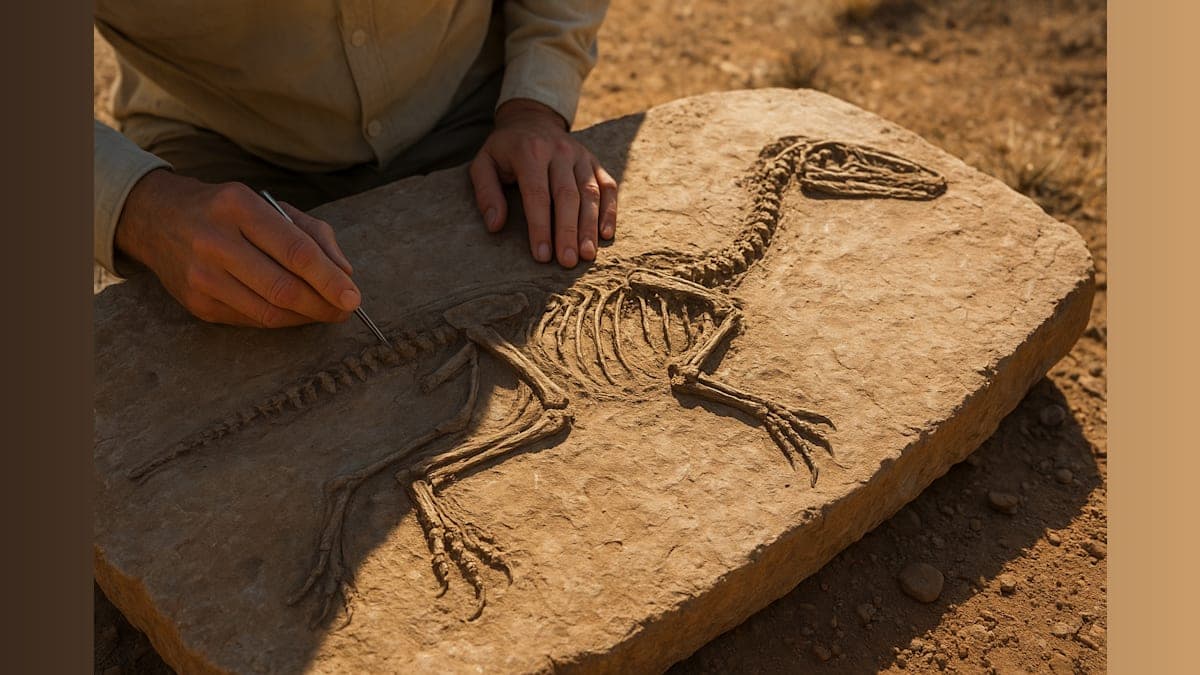
A groundbreaking paleontological discovery has emerged from the fossil-rich landscapes of Patagonia, Argentina, offering scientists an unprecedented window into the evolutionary history of a peculiar group of prehistoric creatures. The remarkably complete skeleton of a tiny bird-like dinosaur has been identified as a crucial specimen that bridges significant gaps in scientific understanding of these enigmatic animals.
The fossil, designated Alnashetri cerropoliciensis, represents a member of the Alvarezsaurs, a distinctive group of dinosaurs characterized by their diminutive teeth and abbreviated forelimbs terminating in a single prominent thumb claw. For decades, these creatures have confounded researchers, primarily because well-preserved specimens were predominantly located in Asian deposits, while South American fossil records remained fragmentary and challenging to interpret.
A Decade of Meticulous Research
The fossil was unearthed in 2014 in northern Patagonia by an international research team led by Professor Peter Makovicky of the University of Minnesota Twin Cities and Dr. Sebastian Apesteguía, an Argentinean colleague. The subsequent decade was devoted to the painstaking process of preparing and assembling the delicate skeletal elements, a procedure requiring exceptional care to prevent damage to the small bones.
Professor Makovicky characterized the significance of the discovery in compelling terms, stating that the transition from fragmentary skeletal remains to a near-complete articulated specimen represents a paleontological equivalent of the Rosetta Stone. This reference point now enables researchers to accurately identify previously ambiguous fossil fragments and chart evolutionary transitions in anatomical features and body dimensions.
Challenging Previous Assumptions
Microscopic examination of the fossilized bones confirmed that the specimen was an adult individual of at least four years of age at the time of death. Weighing less than two pounds, Alnashetri ranks among the smallest dinosaurs documented from South America. For context, the largest species within the Alvarezsaur group reached approximately human size, which is notably diminutive by dinosaurian standards.
The anatomical features of Alnashetri have prompted a reassessment of evolutionary pathways within this dinosaur lineage. Unlike its later evolutionary relatives, this specimen possessed elongated forelimbs and more substantial dentition. These characteristics provide evidence that certain Alvarezsaurs underwent miniaturization well before developing the specialized anatomical adaptations that researchers believe facilitated an insectivorous, particularly ant-eating, dietary strategy.
Global Distribution and Ancient Geography
The research team attributes the worldwide distribution of Alvarezsaurs to the geological fragmentation of the Pangea supercontinent. This massive landmass began breaking apart during the Mesozoic Era, creating the continents recognized today. The dispersal of these dinosaurs across multiple continents reflects this profound geological transformation.
Dr. Apesteguía, a researcher at Universidad Maimónides in Buenos Aires, emphasized the exceptional value of the La Buitrera fossil site. After more than two decades of systematic excavation, this location has yielded unparalleled insights into small dinosaurs and other vertebrate species, establishing itself as a site of singular importance in South American paleontology.
Implications for Future Research
Professor Makovicky indicated that the discovery has illuminated how the Alvarezsaur lineage evolved, underwent size reduction, and dispersed across the prehistoric world. Furthermore, he revealed that additional specimens representing subsequent chapters in the evolutionary narrative of these creatures have already been recovered and are currently undergoing laboratory preparation.
This discovery underscores the continuing importance of paleontological fieldwork in regions such as Patagonia, where exceptional preservation conditions and dedicated research efforts combine to produce transformative scientific findings. As researchers continue to analyze this specimen and prepare related materials, the scientific community anticipates further revelations regarding the evolution and ecology of these remarkable diminutive dinosaurs that once inhabited the ancient landscapes of South America.