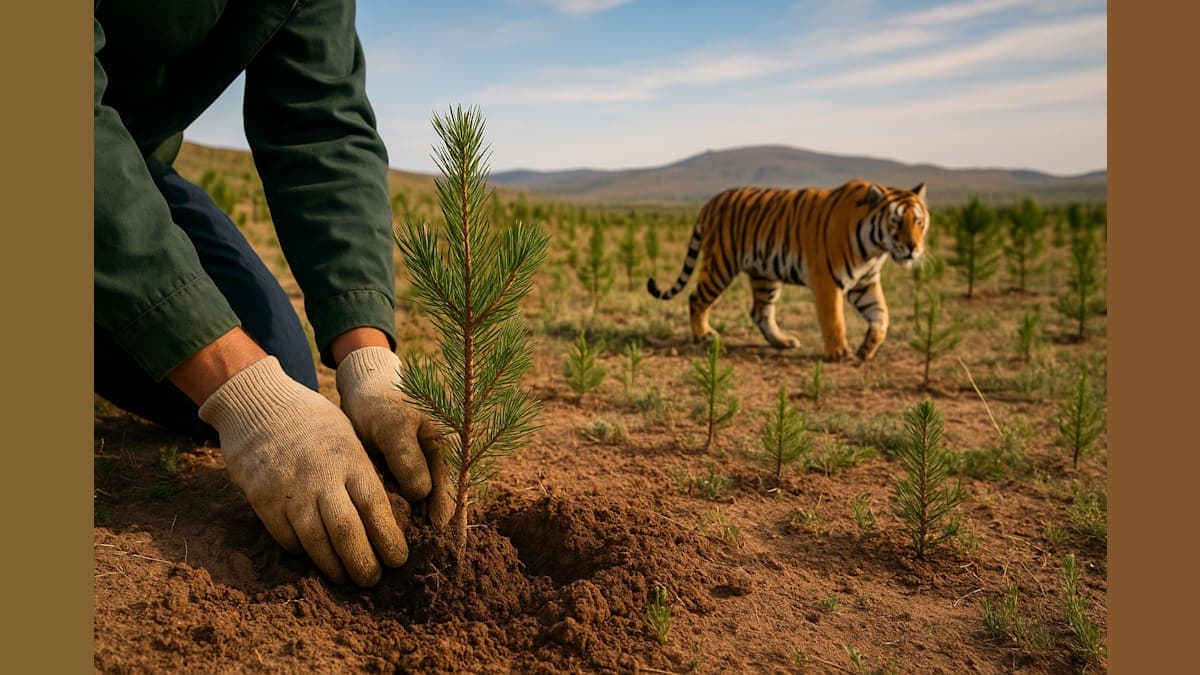
Kazakhstan is on the verge of achieving a remarkable conservation milestone as the nation prepares to welcome tigers back to its southern territories for the first time in decades. The ambitious rewilding program, centered at the Ile-Balkhash Nature Reserve, represents one of the most comprehensive ecosystem restoration efforts currently underway anywhere on Earth.
In 2024 alone, conservation teams planted 37,000 young trees along the riparian woodlands surrounding the Ile River and its delta at Lake Balkhash. This effort builds upon previous years of sustained reforestation work, with a total of 50,000 trees planted between 2021 and 2024 throughout the reserve.
Foundation for Sustainable Ecosystems
Aibek Baibulov, Project Manager for Forest Restoration in Kazakhstan at WWF Central Asia, emphasized that the initiative extends far beyond simple tree planting. According to Baibulov, the work represents the establishment of resilient ecosystems capable of sustaining themselves over the long term.
The results have already begun to demonstrate success. Trees planted in previous years have reached heights of up to 2.5 meters, with root systems extending deep enough to access groundwater. These maturing plants are now forming natural communities, creating the tugai forest habitat essential for supporting wildlife populations.
Baibulov stated that restoring these tugai forests forms the foundation for wildlife return to the region, noting that stable animal populations, including tigers, cannot exist without healthy ecosystems. The project has received support from local residents and multiple partner organizations working in collaboration.
Historic Conservation Achievement
The program, led by the government of Kazakhstan with support from WWF Central Asia and the United Nations Development Program, could mark the first successful reintroduction of tigers to a range country where the species currently faces extinction. Genetic analysis of historical specimens, including bones and furs preserved in national collections, revealed that tiger populations historically inhabiting the region between Iran, southern Russia, Central Asia, and areas around the Caspian Sea shared remarkable genetic similarity with contemporary Siberian tigers.
In preparation for the reintroduction, two Amur tigers named Bodhana and Kuma were transported from the Netherlands to a semi-natural holding facility within the Ile-Balkhash Nature Reserve. The male and female pair have been acclimating to local climate conditions, with conservationists hopeful that breeding will occur. Their potential offspring would constitute the second group of tigers released into the reserve environment.
Rebuilding the Prey Base
The tiger reintroduction represents the culmination of years of preparatory work focused on establishing adequate prey populations. Conservation efforts have achieved remarkable success in restoring saiga antelope numbers, which rebounded from a critically low 48,000 individuals in 2005 to more than 1.9 million animals today.
Additionally, Bukhara deer were released into the reserve beginning in 2019, with approximately 200 individuals introduced over subsequent years to establish a sustainable population capable of supporting tiger predation.
The tree species selected for planting reflect the dietary requirements of these prey animals. The reforestation effort included 5,000 willow seedlings, 30,000 long-leaved oleasters, and 2,000 turanga trees, a native poplar species holding cultural significance for Kazakhs. These plantings extend along a 2.4-mile stretch of Lake Balkhash, which stands as the largest lake in Central Asia following the disappearance of the Aral Sea.
According to WWF Central Asia representatives, wild ungulates have already been observed foraging at the restored sites, indicating that ecosystem function has begun to establish itself. Each planted seedling therefore represents a direct contribution toward creating viable tiger habitat in Kazakhstan.
Imminent Arrivals and Conflict Management
Daniyar Turgambayev, Chairman of the Committee for Forestry and Wildlife of the Ministry of Ecology and Natural Resources, recently announced that the first wild Amur tigers from Russia are expected to arrive in Kazakhstan within the coming months. The nation anticipates receiving three to four tigers before June.
In preparation for this arrival, authorities will establish a working group tasked with developing programs to minimize human-wildlife conflict. Russian specialists will provide training to Kazakh personnel on managing conflicts between human populations and large predators, ensuring that both communities and wildlife can coexist safely.
This comprehensive approach to tiger reintroduction demonstrates Kazakhstan's commitment to evidence-based conservation. By addressing habitat restoration, prey population recovery, and human-wildlife coexistence simultaneously, the program establishes a model for similar rewilding efforts worldwide. The success of this initiative could provide valuable insights for conservation programs in other regions seeking to restore apex predators to their historical ranges.