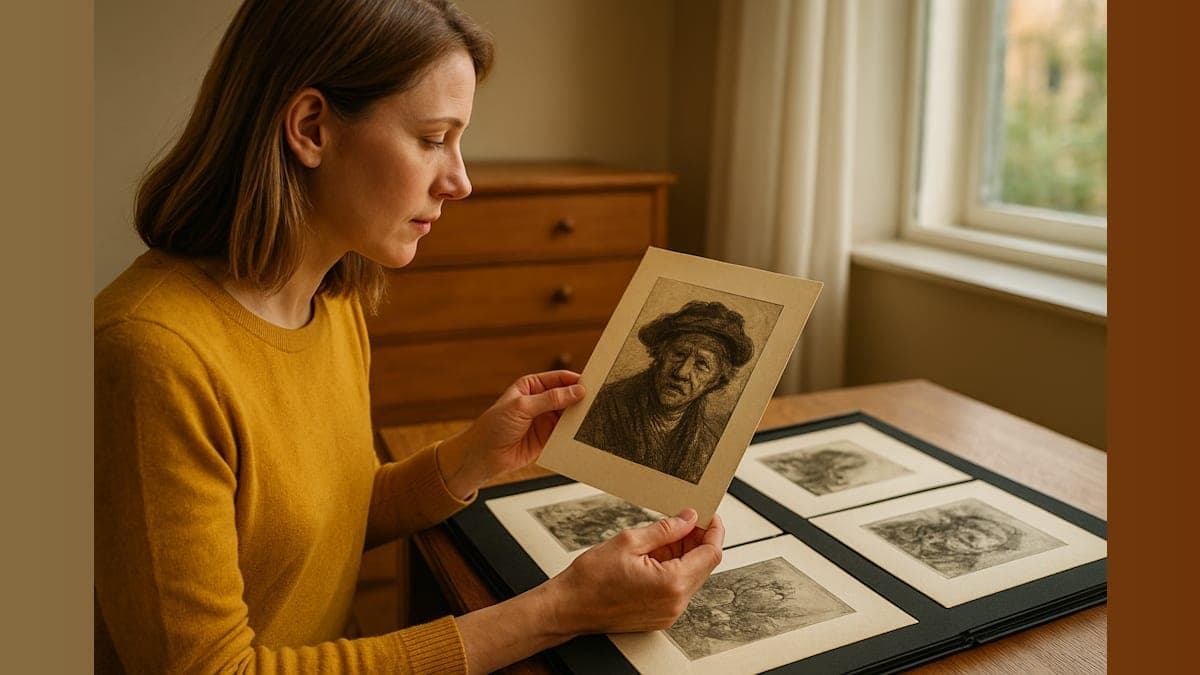
The unexpected consequences of government-mandated lockdowns during the COVID-19 pandemic led one Dutch woman to an extraordinary discovery that would alter the course of her life. Charlotte Meyer, confined to her Amsterdam home, decided to examine a folder of prints and etchings that had been passed down through her family for generations. What she found within those pages would prove to be a treasure trove of historic proportions.
The collection contained 35 authentic etchings by Rembrandt van Rijn, the Dutch Golden Age master whose works command millions of dollars at auction. Each piece bore the artist's signature, yet Meyer remained cautious about her discovery, concerned that approaching experts might reveal them as forgeries and waste valuable time.
A Grandfather's Prescient Investment
The story of these etchings begins in the early twentieth century, when Meyer's grandfather assembled the collection between 1900 and 1920. During that era, etchings held little appeal for most collectors, making them accessible to those with modest means. Meyer explained that her grandfather acquired all 35 pieces for just a few guilders each, a sum that would translate to several thousand dollars in contemporary currency when adjusted for gold prices.
The prescience of this investment becomes clear when examining current market values. A Rembrandt print—not even an original work—recently sold for $4.1 million at a Christie's auction, demonstrating the extraordinary appreciation these works have experienced over the past century. Some of the etchings in Meyer's collection measure only a few inches in length, yet their historical and artistic significance far exceeds their physical dimensions.
Expert Authentication Confirms the Discovery
When Meyer finally summoned the courage to contact professionals, a team of appraisers from the Stedelijk Museum Amsterdam arrived to examine the collection. Their assessment delivered news that exceeded even her most optimistic expectations. According to Meyer's account to Dutch media outlet Omroep Gelderland, the experts informed her that she had no comprehension of the magnitude of her possession.
Meyer characterized the experience as a narrative that exists only in dreams, a sentiment that reflects the rarity of such discoveries. While stories of masterworks emerging from attics, basements, and storage facilities appear with surprising regularity, each instance represents a unique convergence of preservation, inheritance, and recognition.
From Private Collection to Public Exhibition
The discovery has transformed Meyer's relationship with art history. She has embarked upon a journey as a collector of Rembrandt etchings, building upon her grandfather's foundation. The entire collection of 35 etchings now forms the centerpiece of a museum exhibition titled "Rembrandt: From Dark to Light" at the Stedelijk Museum Zutphen.
Meyer has assumed an active role in sharing her family's legacy with the public. She will conduct a guided tour of the exhibition on March 29th, providing visitors with personal insights into the collection's history and her grandfather's collecting philosophy during an era when such works garnered little attention from the broader art market.
The Broader Context of Art Discoveries
Meyer's discovery joins a distinguished list of recent art historical revelations. A painting by a Renaissance master recently surfaced in North Carolina after remaining unrecognized for a century. Another family discovered that a work hanging in their living room was an original Delacroix. A seventeenth-century Dutch painting rescued from a Connecticut attic subsequently sold for $7 million at auction.
These discoveries underscore the importance of proper authentication and the potential value residing in inherited collections. They also highlight how shifting tastes and market dynamics can dramatically alter the perceived worth of artistic works across generations. What Meyer's grandfather purchased as affordable decorative pieces have become museum-quality treasures that illuminate the artistic genius of one of history's greatest masters.
The exhibition at Stedelijk Museum Zutphen offers the public an opportunity to view these remarkable works and consider the unpredictable paths through which cultural heritage is preserved and transmitted across time.