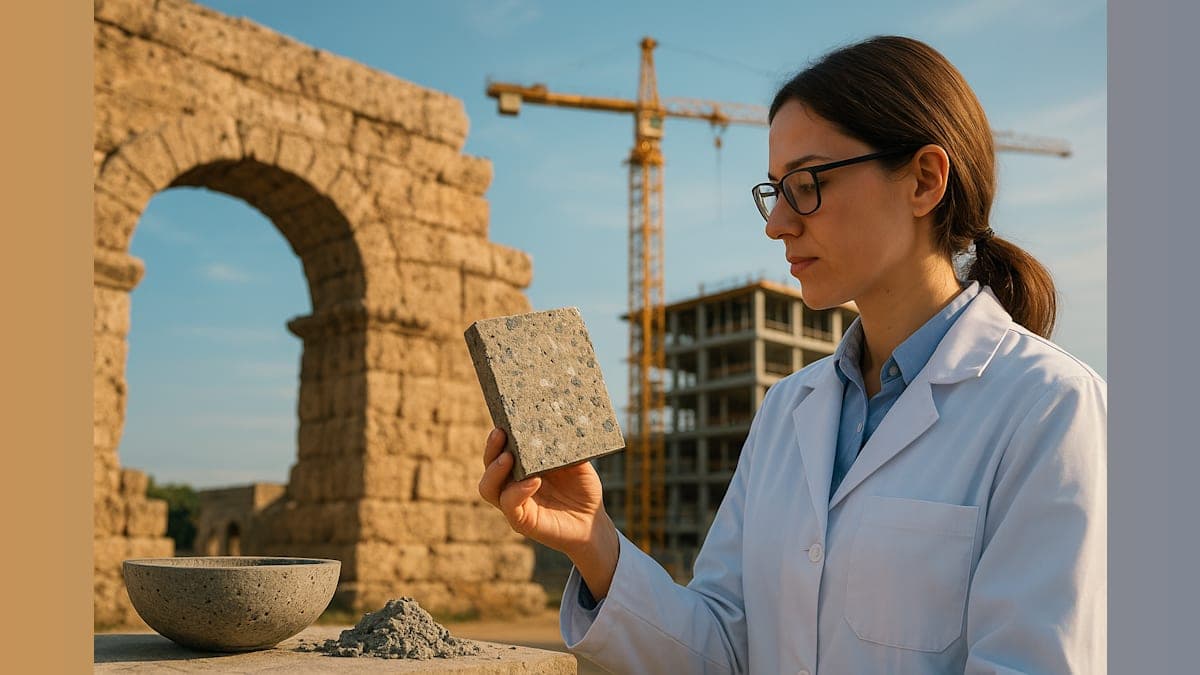
The remarkable longevity of ancient Roman structures has long puzzled engineers and scientists. While modern concrete often deteriorates within decades, Roman buildings have stood for more than two millennia. Now, a scientist who successfully decoded the formula behind Rome's legendary self-healing concrete has taken the bold step of launching a commercial enterprise to bring this ancient technology into the modern construction industry.
The breakthrough came after years of research into the unique properties of Roman concrete, which differs fundamentally from contemporary mixtures. The scientist's theory received compelling validation at an archaeological site in Pompeii, where examination of structures revealed the mechanisms that allowed Roman concrete to repair microscopic cracks autonomously over time.
This convergence of theoretical understanding and physical evidence from one of history's most significant archaeological sites has proven transformative. Three years after confirming the self-healing properties at Pompeii, the researcher has translated academic discovery into practical application by establishing a concrete manufacturing business based on Roman engineering principles.
The implications for modern construction are substantial. Traditional concrete production contributes significantly to global carbon emissions and requires frequent replacement due to degradation. A concrete formulation capable of self-repair could dramatically reduce both environmental impact and long-term maintenance costs for infrastructure projects.
The venture represents a rare instance where ancient wisdom directly informs contemporary innovation. Roman engineers developed their concrete mixture without modern scientific instruments, yet achieved results that surpass many current materials in durability. By reverse-engineering their methods through rigorous scientific analysis, researchers have demonstrated that historical building techniques may offer solutions to present-day challenges.
This development underscores the value of interdisciplinary research that combines archaeology, materials science, and engineering. The success of translating ancient construction methods into a viable business model may encourage similar investigations into other historical technologies that could address modern sustainability concerns.
As infrastructure maintenance becomes an increasingly critical issue for communities worldwide, innovations that extend the lifespan of building materials offer significant economic and environmental benefits. The launch of this Roman-inspired concrete business marks a promising step toward more resilient and sustainable construction practices rooted in proven historical methods.