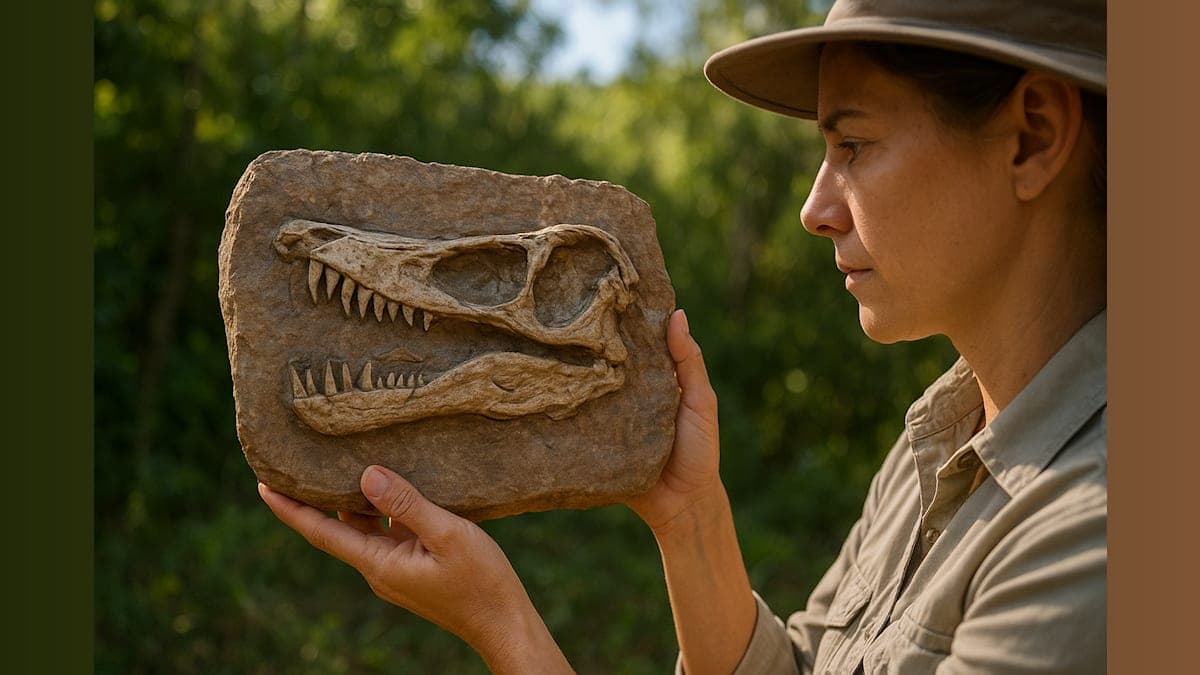
An international team of paleontologists has unveiled the discovery of a remarkably unusual ancient reptile that challenges conventional understanding of early terrestrial life. The creature, formally designated Tanyka amnicola, possessed a bizarrely twisted jawbone with teeth oriented sideways—a configuration that perplexed researchers for years before they confirmed it as an authentic anatomical feature rather than a deformity.
The fossilized remains, consisting of nine separate jawbones, were recovered from a dried riverbed within Brazil's Amazon jungle region. Dating to approximately 275 million years ago, these specimens represent a significant addition to the scientific understanding of the Permian period, when Earth's landmasses were configured into the supercontinent Gondwana.
A Puzzling Anatomical Mystery
Dr. Jason Pardo, the lead researcher from the Field Museum in Chicago, described the extended period of confusion surrounding the specimen's unusual jaw structure. The research team initially suspected the twisted configuration might represent damage or deformation occurring during the fossilization process. However, the consistency of this feature across all nine recovered specimens, including exceptionally well-preserved examples, ultimately confirmed that the twisted jaw represented the creature's natural anatomy.
The distinctive dental arrangement featured teeth pointing outward and to the sides, accompanied by numerous smaller teeth, termed denticles, lining the interior surfaces of the jaws. These denticles formed a grinding surface comparable to a cheese grater, suggesting a feeding mechanism unlike that of contemporary species. Researchers theorize that the lower jaw's denticles rasped against corresponding structures on the upper jaw, creating a unique method of processing food material.
Significance in Evolutionary History
Tanyka amnicola occupies a fascinating position in the evolutionary timeline of tetrapods—four-legged vertebrate animals that include modern reptiles, birds, mammals, and amphibians. The creature belonged to the stem tetrapod lineage, representing an ancient branch that persisted even after more modern tetrapod groups had evolved and diversified. This characteristic prompted Dr. Pardo to compare Tanyka to the modern platypus, describing it as a living fossil during its own era.
The evolutionary significance of Tanyka extends beyond its unusual morphology. According to study co-author Dr. Juan Carlos Cisneros from the Federal University of Piauí in Brazil, the dental characteristics strongly indicate that Tanyka consumed plant material, distinguishing it from the predominantly carnivorous stem tetrapods of its time. This dietary adaptation marks an important milestone in the evolution of herbivory among early terrestrial vertebrates.
Reconstruction and Habitat
Despite the significant findings, substantial aspects of Tanyka's biology remain speculative due to the incomplete nature of the fossil record. Dr. Ken Angielczyk, curator of paleomammalogy at the Field Museum and study co-author, emphasized that definitive conclusions about the creature's complete skeletal structure must await the discovery of more comprehensive remains. The researchers cannot confirm with certainty whether bones found in proximity to the jawbones belonged to the same species.
Based on comparisons with closely related species, researchers estimate that Tanyka may have resembled a salamander with an elongated snout, potentially reaching lengths of up to three feet. The geological context of the fossil-bearing rocks suggests the creature inhabited lacustrine environments—ancient lake systems that characterized the region during the early Permian period.
Window into Ancient Gondwana
The discovery site, located within the Pedra de Fogo Formation in Brazil, represents one of the rare paleontological windows into the fauna of Gondwana during the early Permian period. This supercontinent comprised substantial portions of what would eventually become South America, Africa, Australia, and Antarctica. Dr. Angielczyk noted that specimens like Tanyka provide crucial data regarding the structure and function of ancient ecosystems, including trophic relationships and dietary specializations among community members.
The species name reflects both its distinctive anatomy and geographical context. Tanyka derives from the Guaraní indigenous language, meaning jaw, while the specific epithet amnicola translates to living by the river, acknowledging both the creature's aquatic habitat and the riverbed location where paleontologists recovered the fossils.
The research findings, published in the Proceedings of the Royal Society B, contribute to the expanding knowledge of tetrapod diversification during a critical period in Earth's history. As paleontologists continue to analyze the Pedra de Fogo Formation and similar deposits, additional discoveries may further illuminate the ecological dynamics and evolutionary innovations that characterized life during the transition from the Carboniferous to the Permian period.