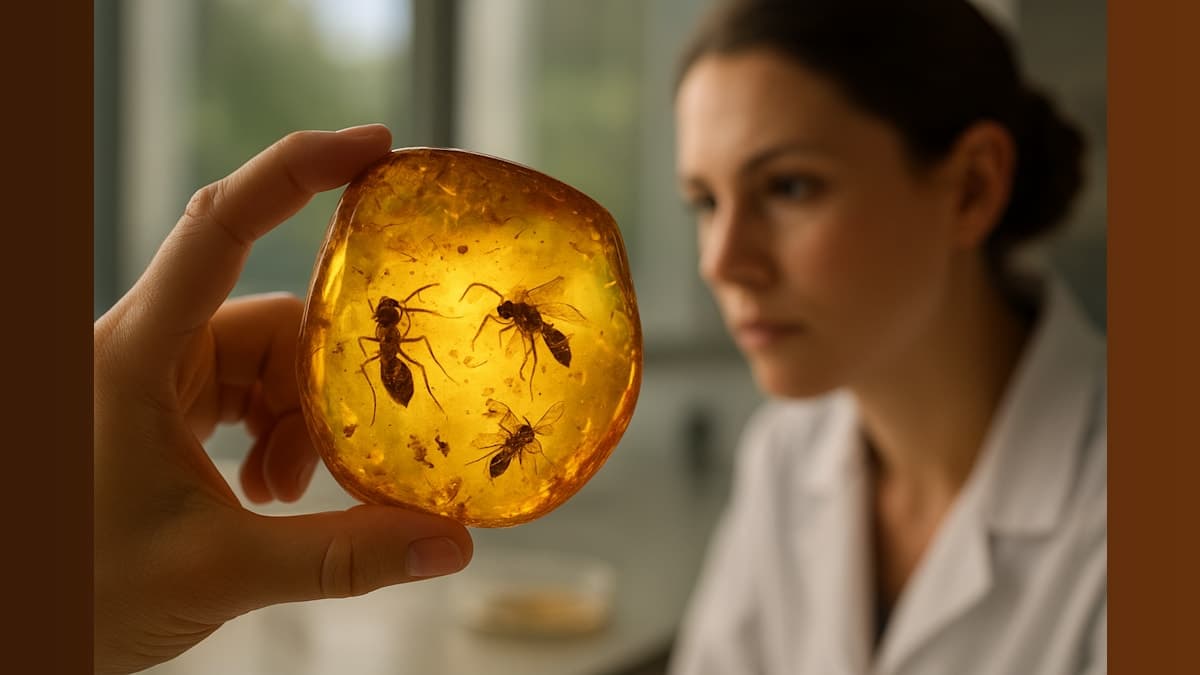
Scientists have uncovered remarkable evidence of ancient insect behavior through the analysis of fossilized tree resin, providing a rare window into ecosystems that flourished millions of years before modern civilization. The research, conducted by specialists at the Institute for Game and Wildlife Research in Ciudad Real, Spain, examined six amber specimens containing preserved insects from periods spanning 99 million to 23 million years ago.
The significance of this discovery lies not merely in the preservation of individual insects, but in the phenomenon known as syninclusion, where multiple organisms of different species are captured together within the same amber specimen. This rare occurrence allows researchers to reconstruct potential ecological relationships and interactions that shaped prehistoric environments.
Frozen Moments in Time
Dr. Jose de la Fuente, the principal investigator of the study, emphasized the exceptional nature of these findings. The amber inclusions serve as snapshots of life on Earth during geological periods when dinosaurs still roamed the planet. The research team examined specimens ranging from the Cretaceous period through the Eocene and Oligocene epochs, with the oldest samples dating to approximately 99 million years ago.
Insects represent critical components of ecological systems, yet their small size and fragile structures make fossilization exceptionally uncommon. Traditional fossil records provide limited information about insect behavior and ecological roles. Amber preservation, however, captures organisms in three-dimensional detail, maintaining their physical relationships to one another at the moment of entombment.
Ancient Ants and Their Companions
The study, published in Frontiers in Ecology and Evolution, focused primarily on fossilized ants, organisms considered particularly important to ecosystem function. The specimens included representatives of Stem ants, the earliest ant species that appeared during the Upper Cretaceous period and left no modern descendants, as well as Crown ants, from which all contemporary ant species evolved. The research also documented Hell ants, an evolutionary offshoot of Stem ants.
Through examination using advanced microscopy, researchers identified three specimens containing ants in close proximity to mites. One particularly intriguing sample, designated as Case 4, preserved a Stem ant positioned approximately four millimeters from a mite. This spatial relationship suggests potential interaction between the two organisms, though the precise nature of that relationship remains subject to interpretation.
Another specimen contained a Crown ant alongside a wasp and two mites positioned so near the ant that researchers hypothesize the mites may have been traveling upon the ant's body. A third sample revealed an even more complex assemblage: three different ant species, a mite, termites, mosquitoes, and an additional winged insect, all preserved within the same amber matrix.
Decoding Ancient Relationships
The central question confronting researchers involves determining whether these organisms were engaged in meaningful ecological interactions or simply became trapped together by circumstance. Dr. de la Fuente proposed multiple interpretations for the ant-mite associations observed in the specimens. The relationship could represent phoresy, a commensal arrangement where mites attach to ants for transportation to new habitats without harming their hosts. Alternatively, the mites may have functioned as parasites, feeding upon the ants during transport.
However, evidence suggests the possibility of mutualistic relationships, wherein both organisms derived benefits from their association. Future investigations employing micro-CT scanning technology could reveal attachment structures on the mites, providing definitive evidence of their capacity to mount and travel upon ant hosts.
One specimen, identified as Case 6, presented additional mysteries. Researchers observed a Stem ant apparently engaged in feeding behavior, preserved alongside a parasitic wasp and a spider. The spider may have employed ant mimicry as camouflage, potentially benefiting from proximity to genuine ants. Another sample contained a Hell ant preserved with a snail, a millipede, and several unidentifiable insects, demonstrating the diversity of organisms that could become trapped simultaneously in flowing tree resin.
Implications for Understanding Ancient Ecosystems
This research contributes substantially to scientific understanding of how ancient ecosystems functioned. The preserved specimens document ecological roles that insects fulfilled millions of years ago, including pollination, parasitism, predation, and prey relationships. These functions remain essential to modern ecosystems, suggesting fundamental continuity in ecological processes across vast stretches of geological time.
The findings also underscore the value of amber as a paleontological resource. Unlike compression fossils formed in sedimentary rock, amber preserves three-dimensional structures and spatial relationships between organisms. This preservation quality enables researchers to formulate and test hypotheses about behavior and interaction that would remain inaccessible through other fossil types.
As analytical technologies continue to advance, specimens such as these will yield increasingly detailed information about prehistoric life. The application of micro-CT scanning, chemical analysis, and other sophisticated techniques promises to extract additional data from amber inclusions, further illuminating the complex web of relationships that characterized ancient terrestrial ecosystems during the age of dinosaurs and beyond.