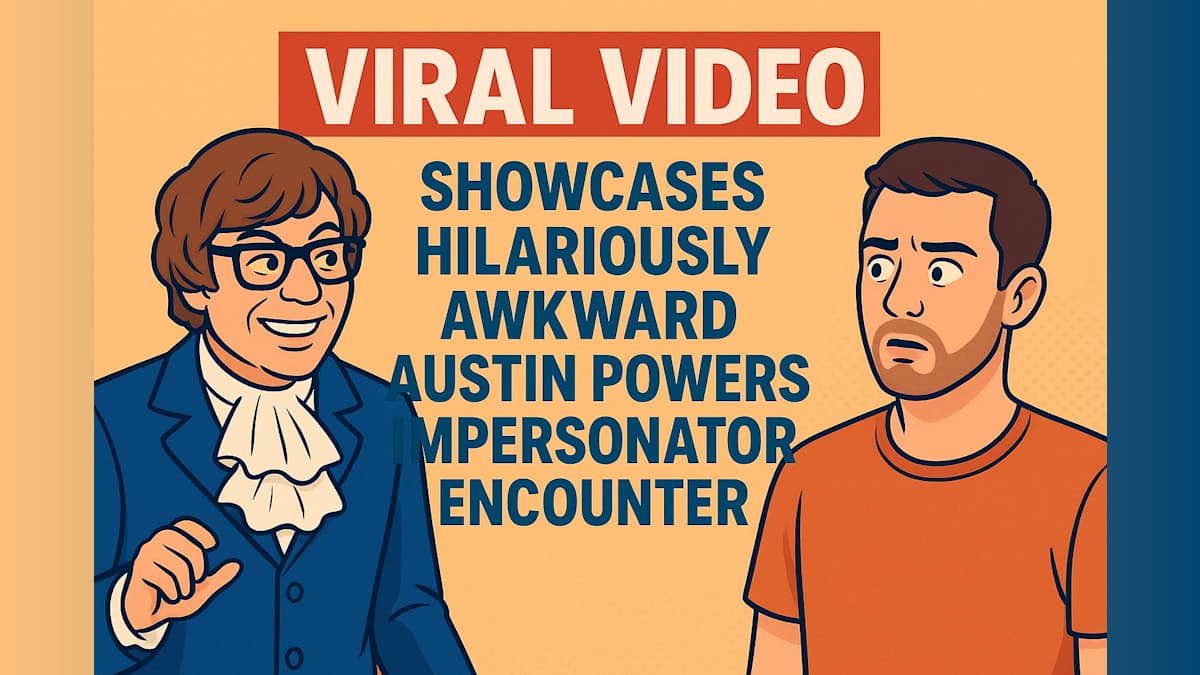
In an era where viral content often emerges from the most unexpected premises, content creator Chase Hofer has delivered a masterclass in awkward comedy. His decision to hire a professional Austin Powers impersonator for a private apartment visit—with no party, no event, just the two of them—has generated significant attention across social media platforms.
The video, which has garnered substantial engagement on both TikTok and Instagram, documents the peculiar encounter between Hofer and Richard Halpern, a Los Angeles-based performer who has portrayed the iconic character professionally for more than 25 years. The exchange captures the essence of cringe comedy while simultaneously serving as a cultural artifact that examines how humor evolves across generations.
The Premise and Execution
The footage begins with Hofer answering his door to find Halpern fully committed to the character, complete with the trademark blue velour suit, frilly white shirt, and thick black-rimmed glasses. The impersonator arrives in character, immediately launching into Austin Powers' distinctive mannerisms and catchphrases.
According to Hofer, the concept originated from a previous experiment with a magician acquaintance. The content creator provided minimal direction to Halpern, allowing the 30-minute session to unfold primarily through improvisation. This approach resulted in moments of genuine discomfort that paradoxically create compelling entertainment.
The video captures Halpern consulting his smartphone to recall specific lines from the film franchise, including dated references that land awkwardly in contemporary context. One particularly telling moment occurs when the impersonator attempts a joke originally designed for a different scenario, prompting Hofer to acknowledge the changed cultural landscape with the observation that it is indeed a different time.
Cultural Context and Commentary
The Austin Powers franchise, created by comedian Mike Myers and directed by Jay Roach, consists of three films that satirized 1960s spy cinema, particularly the James Bond series. The character represented an intentionally exaggerated portrayal of a British international spy whose behavior and dialogue were designed to be deliberately cringe-inducing.
The viral nature of this video has sparked broader discussions about generational perspectives on comedy. Online forums have examined whether younger audiences appreciate the Austin Powers films or find them problematic by contemporary standards. This debate reflects larger conversations about how comedy ages and whether satire maintains its effectiveness when cultural contexts shift.
Social media users have noted the nuanced nature of the character, with some pointing out that despite Austin Powers being portrayed as excessively forward, certain scenes demonstrate unexpected respect for consent—a detail that complicates simple categorizations of the material as either progressive or regressive.
Public Response and Professional Dedication
Comments on the video have praised both participants for their commitment to the concept. Observers noted Halpern's dedication to authenticity, including his arrival in a period-appropriate vehicle adorned with Union Jack imagery. The professional impersonator maintains an active presence on social media, where he advertises his availability for events in the Los Angeles area.
The awkward silences and forced interactions that characterize the video have resonated with audiences precisely because they subvert expectations. Rather than the typical party entertainment scenario for which such services are designed, the intimate apartment setting amplifies the absurdity of the situation.
One particularly memorable sequence shows both men sitting in complete silence while watching a rap performance on television, a moment that encapsulates the peculiar nature of the entire exchange. The juxtaposition of the 1960s-inspired character against contemporary entertainment creates an additional layer of comedic tension.
The Broader Implications
This viral phenomenon demonstrates how content creators continue to find innovative approaches to entertainment in the digital age. By taking a service typically designed for group events and applying it to an intentionally uncomfortable solo context, Hofer has created content that examines the nature of performance, nostalgia, and social interaction.
The video also serves as documentation of how professional entertainers adapt their craft to unconventional circumstances. Halpern's quarter-century of experience portraying the character provided him with sufficient material and confidence to navigate the unusual situation, even as the lack of traditional audience feedback created inherent challenges.
As discussions continue about what constitutes appropriate comedy in contemporary culture, this video offers a case study in how older material can be revisited and recontextualized. The awkwardness itself becomes a form of commentary on the passage of time and changing social norms, making the content relevant beyond its immediate entertainment value.
Whether viewed as pure entertainment, social experiment, or cultural critique, the Austin Powers impersonator video has achieved what all successful viral content accomplishes: it has prompted conversation, generated genuine reactions, and demonstrated the unpredictable nature of what captures public attention in the digital landscape.