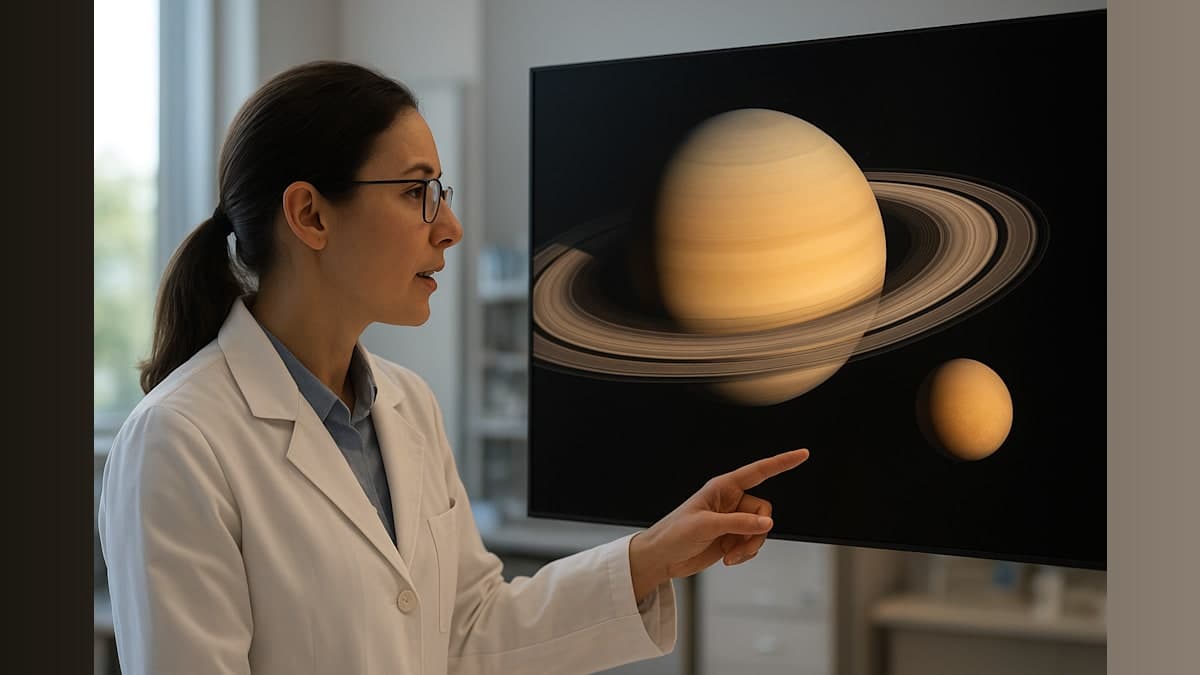
Through an impressive combination of mathematical calculation and scientific deduction, researchers believe they have unraveled one of the solar system's most enduring enigmas: the origin of Titan's extraordinary size and Saturn's characteristic wobble.
Titan, Saturn's largest moon, presents a fascinating paradox to planetary scientists. Despite being larger than the planet Mercury, the mechanisms behind its formation and substantial size have remained unclear. The moon's gravitational influence is so significant that it causes Saturn itself to tilt and wobble, yet the precise chain of events that led to this phenomenon has eluded researchers for decades.
Matija Ćuk, a research scientist at the SETI Institute in Mountain View, California, has proposed an elegant solution to this puzzle. His theory suggests that an ancient collision between Titan and another moon set off a cascade of events that explains not only Titan's size but also Saturn's wobble, tilt, and the formation of its famous ring system.
According to Ćuk's research, which has been accepted for publication in The Planetary Science Journal, a moon approximately one thousand times larger than Hyperion—currently the largest nonspherical moon orbiting Saturn—collided with Titan roughly half a billion years ago. This impact would have enlarged Titan substantially and triggered a series of subsequent collisions among Saturn's inner moons, ultimately creating the planet's distinctive ring system approximately one hundred million years ago.
The researcher synthesized data collected by NASA's Cassini Probe, which observed Saturn between 2004 and 2017, with contemporary research and computer simulations to develop his comprehensive theory. Ćuk characterized his findings as explaining "everything" about Saturn's current configuration.
The breakthrough centers on a concept in astronomy known as resonance, which describes how the orbital force of one celestial body can influence another. Scientists previously theorized that Neptune's gravitational pull accounted for Saturn's wobble. However, data from the Cassini mission revealed that the two planets were not sufficiently synchronized to support this explanation.
In 2022, researchers proposed an alternative hypothesis involving a lost moon called Chrysalis, which they suggested had spiraled too close to Saturn, disintegrated, and formed the planet's rings while also causing its tilt and wobble. Ćuk's research refines and expands upon this concept with more precise calculations.
Through careful analysis, Ćuk determined that Saturn's current wobble is slightly too rapid to be explained by Neptune's resonance alone. However, when calculating backwards in time to the period when Saturn's rings are believed to have formed, the wobble aligns much more closely with Neptune's influence. The addition of an extra moon—the proto-Hyperion—into the calculations makes the resonance between Neptune and Saturn exact.
This mathematical precision suggests that when Saturn possessed both the proto-Hyperion moon and a smaller proto-Titan, its resonance with Neptune fit established calculations for planetary orbital interactions. The collision between these moons would have accelerated Saturn's wobble, explaining why previous Neptune-based theories appeared improbable.
Independent experts have responded favorably to Ćuk's theory. William B. Hubbard, professor emeritus of planetary sciences at the University of Arizona, concluded that the new theory fits the available evidence better than earlier hypotheses about the Chrysalis moon. Carl Murray, an emeritus professor of mathematics and astronomy at Queen Mary University of London and former member of the Cassini team, characterized the theory as "highly probable."
The research underscores an important reality about scientific exploration: even as advanced instruments like the James Webb Space Telescope reveal distant galaxies and expand our understanding of the universe, significant mysteries remain within our own solar system. Saturn, with its 274 moons, continues to challenge researchers and reward careful investigation.
This discovery represents a significant advancement in planetary science, demonstrating how the integration of historical mission data with contemporary analytical techniques and computer modeling can unlock answers to questions that have puzzled astronomers for generations. The theory's elegance lies in its ability to provide a unified explanation for multiple seemingly unrelated phenomena through a single ancient event.