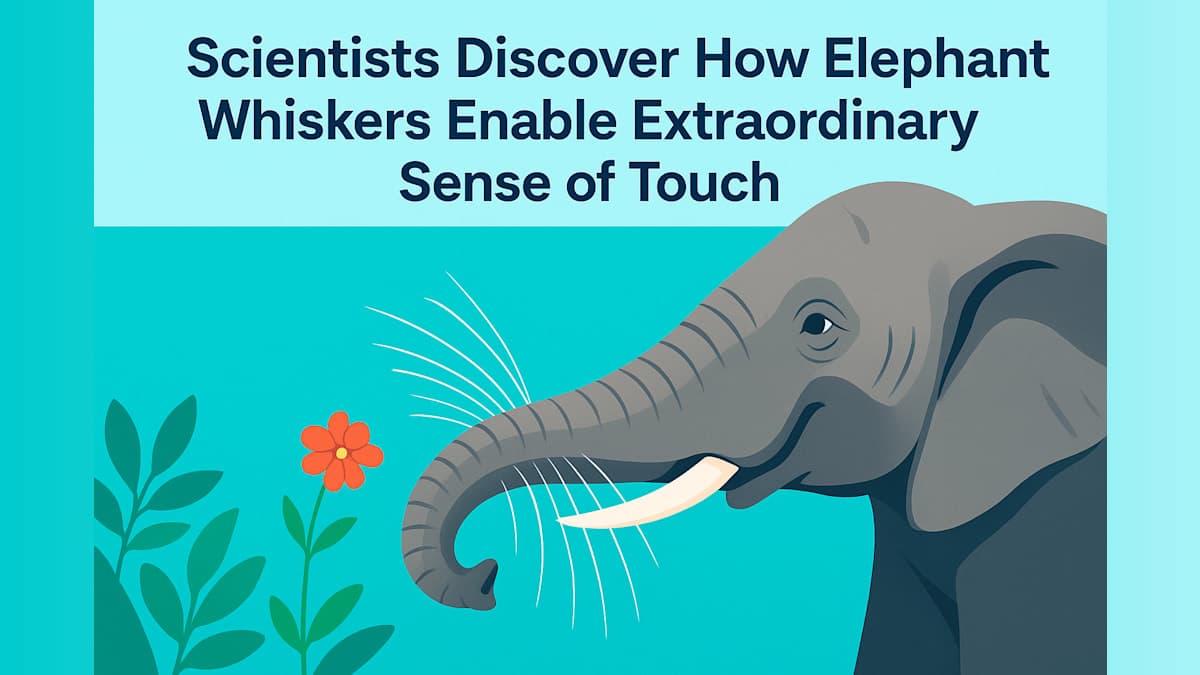
A team of German researchers has uncovered the remarkable secret behind one of nature's most versatile appendages: the elephant's trunk. The breakthrough study reveals that specialized whiskers covering the trunk possess extraordinary properties that enable these massive land mammals to execute tasks requiring astonishing delicacy and precision.
The research demonstrates that approximately 1,000 hairs distributed across an elephant's trunk feature an unusual structural characteristic that scientists describe as a functional gradient. Unlike the uniformly stiff whiskers found in rodents such as rats and mice, elephant whiskers possess rigid bases that gradually transition to soft, rubber-like tips. This distinctive architecture provides elephants with what researchers term a tactile map, allowing them to determine precisely where contact occurs along each individual whisker.
Dr. Andrew Schulz, who led the research team, explained the significance of this discovery. The stiffness gradient functions as an inherent sensory system, enabling elephants to gauge the distance between their trunk and objects in their environment. This capability is integrated directly into the physical properties of the whiskers themselves, including their geometry, internal structure, and material composition.
"Engineers call this natural phenomenon embodied intelligence," Dr. Schulz stated, emphasizing the remarkable nature of this biological adaptation. The property allows elephants to accomplish impressive feats of dexterity, such as grasping a single peanut or lifting a tortilla chip without causing it to break or crumble.
The research team employed advanced micro-CT scanning technology to examine the three-dimensional structure of elephant whiskers. The analysis revealed that these specialized hairs possess a thick, blade-like shape with a flattened cross-section. Contrary to the researchers' initial hypothesis that they would resemble rat whiskers, the internal architecture proved more similar to structures found in sheep horns and horse hooves, featuring hollow bases and elongated internal channels.
This porous construction serves multiple functions. The reduced mass makes the whiskers lighter while simultaneously providing impact resistance. This durability proves essential given that elephants consume hundreds of kilograms of vegetation daily, subjecting their whiskers to constant contact with various surfaces. The robust design becomes even more critical considering that elephant whiskers, unlike those of many other mammals, do not regenerate once damaged.
To better understand how the stiffness gradient affects sensory perception, Dr. Schulz collaborated with colleagues at the Max Planck Institute for Intelligent Systems in Stuttgart. The team fabricated a scaled-up prototype whisker using three-dimensional printing technology, creating a model with a rigid, dark base transitioning to a soft, transparent tip.
Professor Katherine Kuchenbecker, Dr. Schulz's mentor, made a serendipitous observation while carrying the prototype through the institute's corridors. As she lightly tapped the model against columns and railings, she discovered that contact at different points along the artificial whisker produced distinctly different sensations. Touches near the soft tip felt gentle and cushioned, while contact near the rigid base produced sharp, strong feedback. Significantly, she could identify the contact location without visual confirmation, relying solely on tactile sensation.
Building upon these empirical observations, the research team developed sophisticated computational models to simulate whisker behavior during contact events. The simulations confirmed their hypothesis: the transition from a stiff base to a compliant tip substantially enhances the ability to determine contact location along the whisker's length. This sensory precision enables elephants to modulate their responses appropriately and manipulate even fragile objects with care.
The implications of this research extend beyond understanding elephant biology. The team has expressed enthusiasm about applying these natural principles to technological applications, particularly in robotics and intelligent systems design. Dr. Schulz noted that artificial sensors incorporating elephant-inspired stiffness gradients could deliver precise spatial information with minimal computational requirements, achieving efficiency through intelligent material design rather than complex processing algorithms.
This discovery represents another example of how studying biological systems can inspire innovative engineering solutions. As researchers continue to decode the sophisticated mechanisms that evolution has refined over millions of years, the potential for developing advanced technologies that mirror nature's elegant solutions continues to expand. The elephant's trunk, already recognized as one of the animal kingdom's most remarkable organs, has now revealed yet another layer of its extraordinary capabilities.