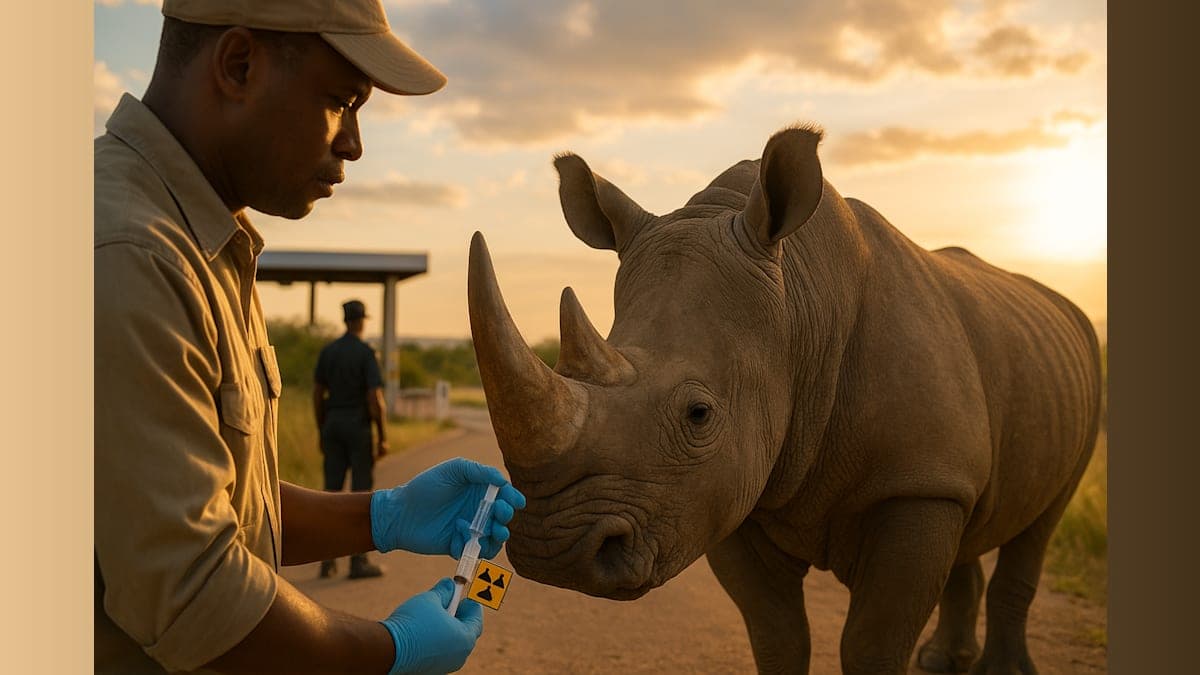
A groundbreaking conservation initiative in South Africa has introduced a novel weapon in the ongoing struggle to protect rhinoceros populations from illegal poaching. The Rhisotope Project, developed by researchers at the University of Witwatersrand-Johannesburg, utilizes radioactive isotope technology to render rhino horns virtually impossible to smuggle across international borders.
The innovative approach involves embedding non-harmful radioactive isotopes directly into the keratin structure of rhinoceros horns. This strategic application leverages existing global security infrastructure designed to prevent nuclear terrorism and weapons proliferation. With approximately 11,000 radiation detection devices installed at ports of entry across more than 200 nations, traffickers would find it extraordinarily difficult to transport treated horns without detection.
Addressing Safety Concerns Through Rigorous Testing
Initial skepticism regarding potential harm to the animals prompted extensive scientific evaluation. In 2024, researchers conducted a comprehensive six-month monitoring period involving 20 rhinoceroses at a nursery facility within the UNESCO Waterberg Biosphere Reserve in Limpopo province. The animals underwent continuous observation and biological testing to assess any adverse effects from the isotope implantation.
Utilizing biological dosimetry techniques, scientists analyzed blood samples for micronuclei formation in white blood cells, a recognized indicator of cellular damage. The results demonstrated no detectable harm to the treated animals, establishing the procedure as both safe and effective. Professor James Larkin, the project's Chief Scientific Officer and the originator of the isotope concept, confirmed that the research had proven the method viable beyond scientific doubt.
Economic and Conservation Implications
The illegal wildlife trade places enormous economic pressure on conservation efforts. Black market valuations estimate rhinoceros horn at approximately $65,000 per kilogram, creating substantial incentives for criminal enterprises despite the material being composed of keratin—the same protein found in human fingernails and hair—with no legitimate medicinal properties.
South Africa hosts the largest rhinoceros population globally, with the majority residing on privately-owned land rather than national parks. Private landowners currently bear significant financial burdens maintaining anti-poaching security teams and implementing traditional deterrent methods such as horn removal, which requires repetition every 18 to 24 months and has been shown to negatively impact rhinoceros social behavior.
Jessica Babich, Chief Executive Officer of the Rhisotope Project, emphasized the long-term cost advantages of isotope treatment. The procedure allows animals to retain their horns while requiring dosage renewal only every five years, potentially reducing operational expenses for conservation programs substantially.
Detection Capabilities and Implementation Challenges
Field testing has confirmed the technology's remarkable effectiveness. Researchers successfully detected the radioactive signature of a single treated horn concealed within a standard 40-foot steel shipping container. Furthermore, even if traffickers attempt to remove the isotope material, residual traces remain detectable on the horn and any surfaces with which it comes into contact.
The project represents the culmination of nearly a decade of development. An earlier attempt to apply nuclear technology to rhinoceros protection in 2015-2016 proved unsuccessful due to impractical field application requirements. Professor Larkin's isotope-based approach resolved these technical limitations, leading to collaboration between the Nuclear Energy Corporation of South Africa, the University of Witwatersrand, and the International Atomic Energy Agency.
Conservation Status and Future Outlook
The International Union for Conservation of Nature currently classifies white rhinoceros populations as Near Threatened and black rhinoceros as Critically Endangered. Poaching pressure continues to threaten these already vulnerable species, making innovative protection strategies increasingly critical.
The Rhisotope Project now seeks partnerships and funding to expand implementation across South Africa's rhinoceros populations. As a non-profit initiative, the organization aims to treat as many animals as possible while maintaining accessibility for both public reserves and private landowners.
Professor Larkin expressed cautious optimism regarding the project's potential impact, stating his hope that widespread adoption of the technology might ensure rhinoceros survival for future generations. The successful deployment of this nuclear-powered conservation tool represents a significant milestone in wildlife protection efforts and demonstrates how innovative scientific applications can address complex environmental challenges.