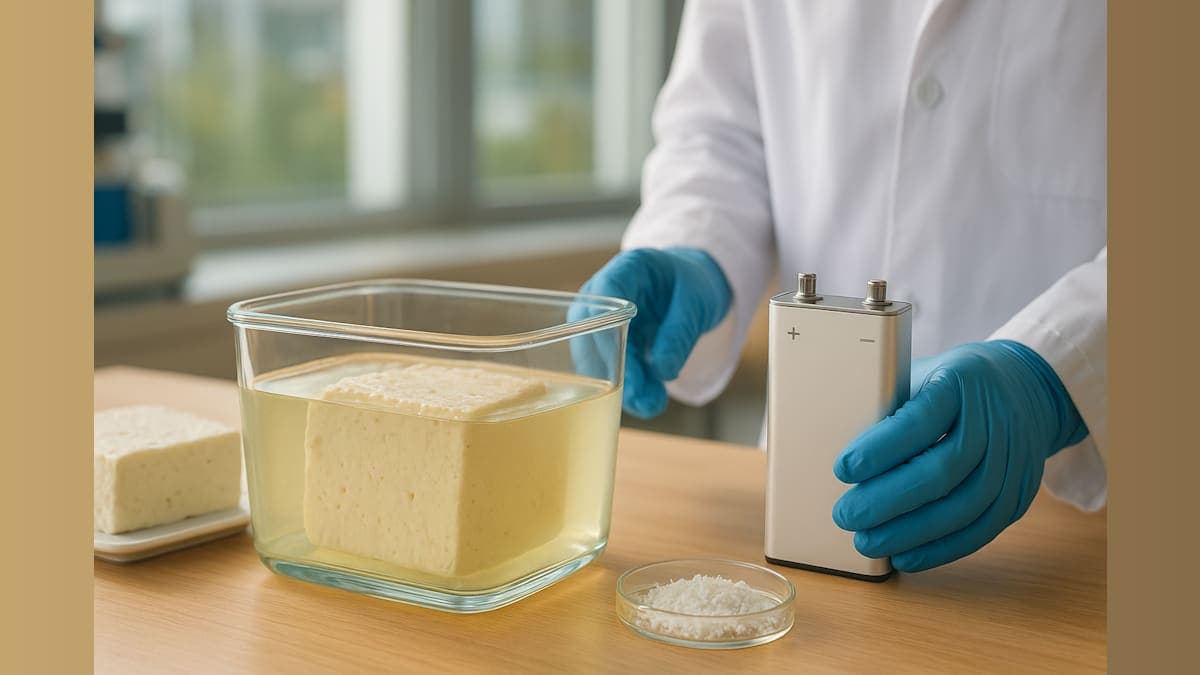
In a remarkable convergence of culinary tradition and cutting-edge technology, scientists in Hong Kong have unveiled a battery design that challenges conventional approaches to energy storage while addressing critical environmental concerns. The breakthrough centers on an unlikely ingredient: the brine solution traditionally employed in tofu production.
The experimental battery demonstrates extraordinary performance capabilities, withstanding an impressive 120,000 charge cycles—a figure that substantially exceeds the longevity of current lithium-ion technology. Furthermore, the device presents minimal environmental hazards upon disposal, addressing one of the most pressing challenges facing the battery industry today.
The innovation lies in the selection of electrolytes, the critical components responsible for facilitating electrical charge transfer between a battery's negative and positive electrodes. Rather than relying on rare earth elements or toxic materials, the Hong Kong research team identified magnesium chloride and calcium chloride as viable alternatives. These compounds, commonly recognized as nigari in East Asian cuisine, serve as the coagulating agent that transforms soy milk into tofu.
The significance of this development extends beyond mere novelty. Current battery technologies frequently incorporate materials that pose substantial environmental risks, both during extraction and at end-of-life disposal. Lithium mining, for instance, requires extensive water resources and can contaminate local ecosystems. The disposal of spent batteries presents additional challenges, as toxic components may leach into soil and groundwater systems.
By contrast, magnesium chloride and calcium chloride occur abundantly in nature and demonstrate considerably lower toxicity profiles. These salts dissolve readily in water and do not accumulate in biological systems, substantially reducing the environmental footprint associated with battery production and disposal. The materials are also significantly less expensive than lithium and cobalt, potentially reducing manufacturing costs.
The research represents a broader trend within materials science toward bio-inspired and food-derived technologies. Scientists increasingly examine traditional processes and natural compounds for solutions to contemporary technological challenges. This approach has yielded innovations ranging from packaging materials derived from seaweed to construction materials incorporating mycelium, the root structure of fungi.
The tofu brine battery remains in experimental stages, and researchers must address several considerations before commercial viability becomes feasible. Energy density—the amount of power stored per unit of volume or weight—requires optimization to compete with established technologies. Manufacturing processes must be refined and scaled to industrial production levels. Additionally, the battery's performance across varying temperature ranges and environmental conditions requires comprehensive testing.
Nevertheless, the exceptional cycle life demonstrated by the prototype suggests promising applications. Stationary energy storage systems, which support electrical grids and renewable energy installations, prioritize longevity and safety over compact size. The tofu brine battery's durability and benign disposal characteristics align well with these requirements.
The development arrives at a critical juncture for energy storage technology. Global demand for batteries continues to escalate, driven by electric vehicle adoption and renewable energy integration. Identifying sustainable alternatives to current battery chemistries has become imperative for environmental protection and resource security.
The Hong Kong team's work exemplifies how innovative thinking, combined with attention to traditional practices, can yield unexpected solutions to modern challenges. As research progresses, the humble tofu brine may contribute significantly to the global transition toward sustainable energy systems.