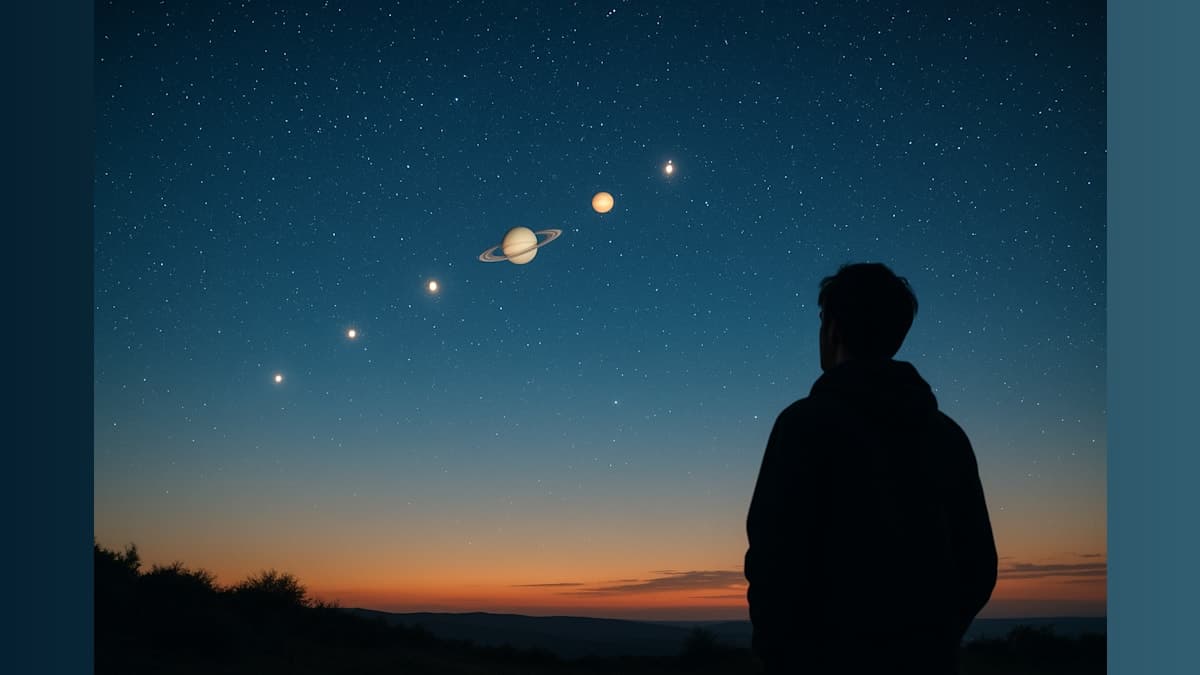
Astronomy enthusiasts and casual stargazers alike will have an extraordinary opportunity this Saturday to witness a remarkable celestial event. On February 28th, six planets in our solar system will appear clustered together in the night sky, creating what astronomers refer to as a planetary alignment or 'planet parade.'
Mercury, Venus, Jupiter, Saturn, Uranus, and Neptune will all be visible in the western sky approximately thirty minutes after local sunset. This phenomenon occurs when multiple planets, which orbit along the same horizontal plane known as the ecliptic, pass by the same point in the sky simultaneously.
Understanding the Rarity of the Event
While planetary alignments occur with some regularity, the number of planets involved determines the rarity of the spectacle. The greater the number of aligned planets, the more exceptional the event becomes. Notably, a similar alignment occurred almost exactly one year ago, on February 27th, 2024, when all seven other planets appeared in a rough line. According to astronomical projections, such a comprehensive alignment will not occur again until 2040.
The current six-planet alignment represents a significant astronomical event, though observers should understand that planetary parades themselves are not exceptionally uncommon. Each additional planet that joins the alignment, however, exponentially decreases the likelihood of the occurrence.
Viewing Guidelines for Local Observers
Four of the six planets—Mercury, Venus, Jupiter, and Saturn—will be visible to the naked eye, making this event accessible to viewers without specialized equipment. Uranus and Neptune, positioned at considerably greater distances from Earth, will require binoculars or a telescope for observation.
The planetary configuration will present itself in a distinctive pattern. Mercury, Venus, Saturn, and Neptune will appear in close proximity, forming a somewhat linear arrangement. Uranus will be positioned approximately forty degrees to the left of this grouping, while Jupiter will appear roughly ninety degrees away from the main cluster.
While observers with proper equipment can currently view all the planets in the night sky, February 28th represents the optimal viewing date when the planets will appear closest together from our terrestrial vantage point.
Locating the Planets in the Night Sky
Observers worldwide should direct their attention toward the western horizon approximately thirty minutes following local sunset. The planets will not appear high in the sky but will be positioned well above the horizon line.
Venus serves as an excellent reference point for locating the other planets. Identifiable by its bright appearance and distinctive red glow, Venus will anchor the viewing experience. Mercury can be found in close proximity to Venus, positioned upward and to the right. Saturn will appear upward and to the left of Venus, with Neptune—the faintest of the visible planets—positioned virtually adjacent to the ringed giant.
Maximizing the Viewing Experience
For optimal viewing conditions, observers should seek locations with minimal light pollution and unobstructed views of the western horizon. While urban environments may present challenges due to artificial lighting, the brightness of Venus, Jupiter, and Saturn should make them visible even from moderately light-polluted areas.
Those wishing to observe Uranus and Neptune should prepare binoculars or telescopes in advance and allow their eyes several minutes to adjust to darkness. Star charts or astronomy applications can provide additional assistance in precisely locating these more distant worlds.
This planetary alignment represents a valuable educational opportunity for families and students interested in astronomy. The event offers a tangible connection to our solar system and demonstrates the predictable mechanics of planetary motion that govern our cosmic neighborhood.