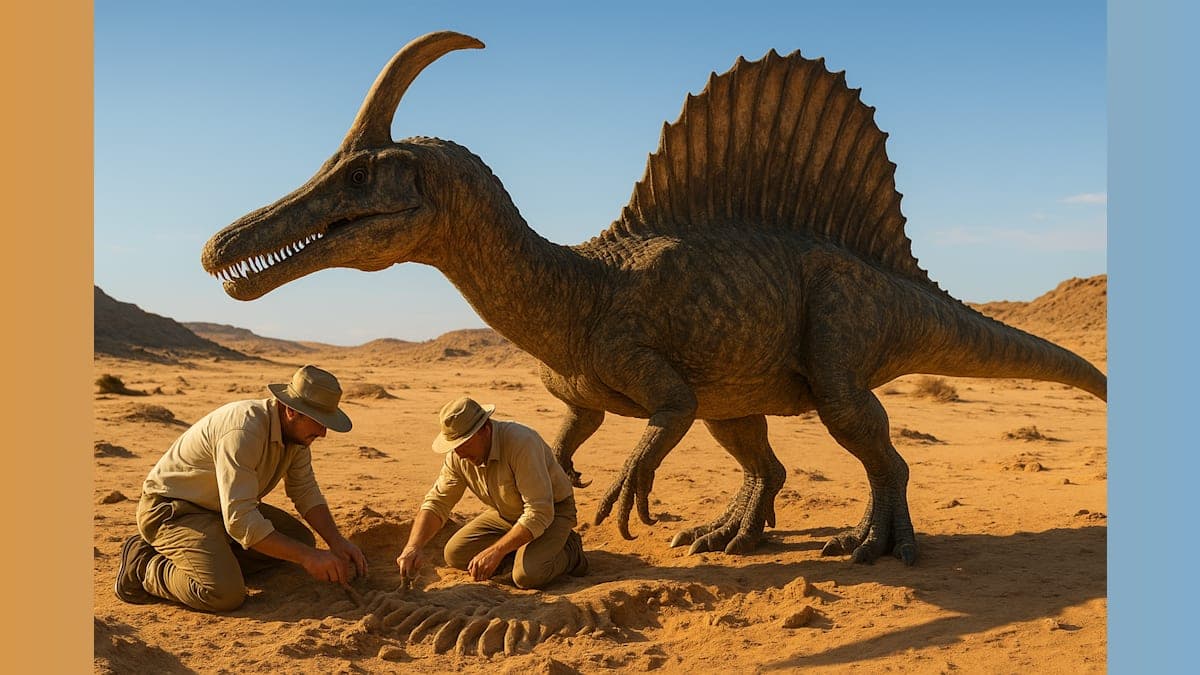
The scientific community has announced an extraordinary paleontological breakthrough following the discovery of a previously unknown dinosaur species in the Sahara Desert. This newly identified member of the Spinosaurus family represents the first indisputable evidence of a new species within this genus in over one hundred years, marking a significant milestone in the field of vertebrate paleontology.
The specimen, recovered from a remote and challenging location within the vast Saharan landscape, exhibits a remarkable scimitar-shaped cranial crest that distinguishes it from other known theropod dinosaurs. Researchers have characterized this ancient predator as a specialized piscivore, colloquially termed a "hell heron" due to its apparent adaptation for fish consumption despite inhabiting an environment situated hundreds of miles from any coastal regions.
The discovery challenges conventional understanding of prehistoric ecosystems and suggests that extensive freshwater systems once traversed areas that are now among the most arid regions on Earth. The presence of a fish-eating dinosaur in what is currently desert terrain provides compelling evidence that the Sahara supported complex aquatic environments during the Cretaceous period, approximately 95 to 100 million years ago.
Paleontologists involved in the research have described the findings as "astonishing," noting that such discoveries illuminate the extraordinary diversity of prehistoric life. The distinctive cranial morphology of this Spinosaurus species suggests specialized feeding behaviors and ecological niches that researchers are only beginning to comprehend. The scimitar-shaped crest may have served multiple functions, potentially including species recognition, thermoregulation, or display purposes during mating rituals.
The Sahara Desert has emerged as an increasingly important location for paleontological research, with scientists recognizing that beneath its shifting sands lie remnants of dramatically different ancient environments. The extreme conditions that now characterize the region have paradoxically helped preserve fossil specimens, protecting them from the weathering and biological degradation that affect remains in more temperate climates.
This discovery underscores the potential for future paleontological revelations in understudied regions. Researchers have indicated that remote desert locations may harbor additional undiscovered species, effectively representing "lost worlds" that await systematic exploration. The logistical challenges of conducting fieldwork in such inhospitable environments have historically limited comprehensive surveys, suggesting that many significant finds remain buried beneath the desert surface.
The identification of this new Spinosaurus species contributes valuable data to ongoing debates regarding the paleobiology and evolutionary relationships within this enigmatic group of dinosaurs. Spinosaurids have long fascinated scientists due to their unusual adaptations, including elongated skulls, conical teeth suited for grasping slippery prey, and in some species, adaptations for semi-aquatic lifestyles. This latest discovery expands the known diversity of these remarkable predators and provides additional context for understanding their ecological roles in ancient ecosystems.
The research team's findings will undergo rigorous peer review and formal publication in scientific literature, where detailed anatomical descriptions and phylogenetic analyses will be presented. Such documentation is essential for establishing the validity of the new species designation and enabling other researchers to build upon these discoveries. The specimen will likely become an important reference point for comparative studies of Spinosaurus diversity and evolution.
This discovery serves as a reminder of the incomplete nature of the fossil record and the continued importance of paleontological exploration. Each new species identified enhances scientific understanding of Earth's biological history and the processes that have shaped life over geological timescales. As technology advances and previously inaccessible regions become subject to systematic investigation, the potential for transformative discoveries in paleontology remains substantial.