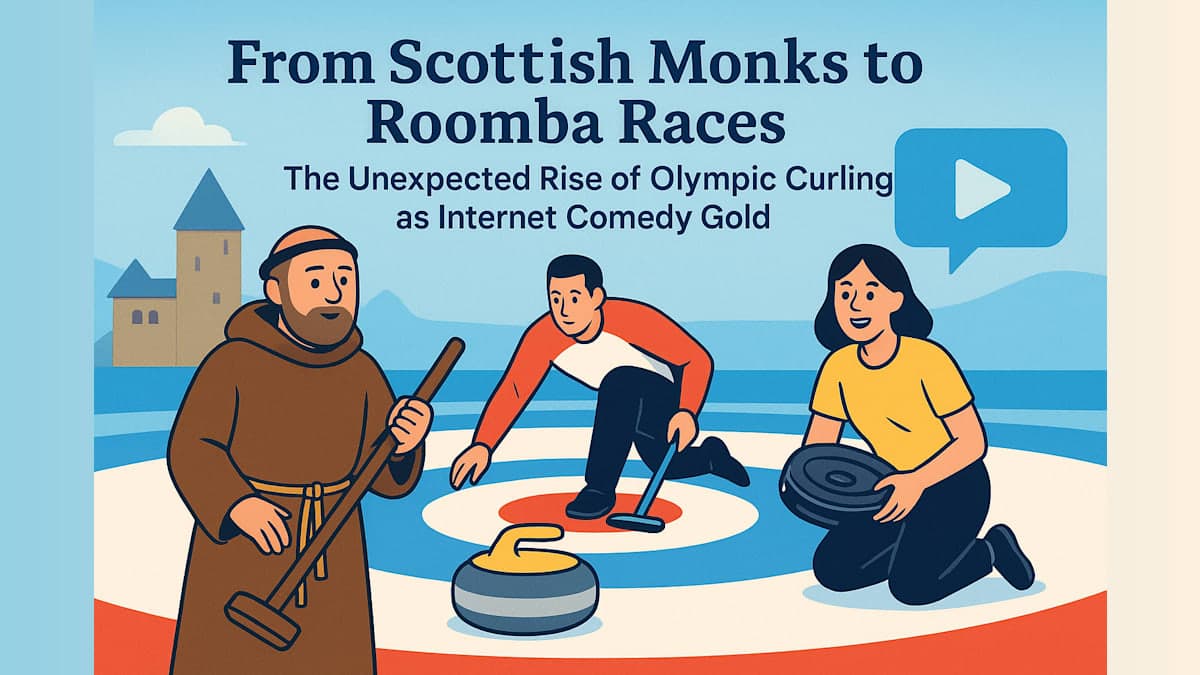
When curling achieved official Olympic sport status in 1998, the reaction from international audiences ranged from bewilderment to outright amusement. The sight of athletes vigorously sweeping ice while a 42-pound granite stone glides toward a circular target appeared, to the uninitiated, more theatrical performance than athletic competition. Nearly three decades later, the sport has experienced a remarkable transformation in public perception, culminating in a wave of humorous home recreations that have flooded social media platforms.
The phenomenon represents more than simple mockery. These viral videos—featuring Roombas as makeshift curling stones and Swiffers replacing regulation brooms—demonstrate genuine affection for a sport that has captivated viewers with its unique combination of strategy, precision, and inexplicable physics.
Ancient Origins Meet Modern Entertainment
The historical trajectory of curling reveals a sport with surprisingly deep roots. Evidence suggests Scottish monks engaged in early versions of the game on frozen lakes and ponds during the 16th century. Agricultural communities adopted the winter pastime, with farmers organizing informal competitions during harsh winter months when field work proved impossible.
The sport underwent significant formalization throughout the 1800s, transitioning from casual recreation to organized competition. Scottish emigrants carried curling traditions to new territories, facilitating its international expansion. By the early 20th century, the sport had migrated indoors, establishing the foundation for modern competitive play.
Understanding the Athletic Demands
The mechanics of curling involve considerably more athletic prowess than casual observation might suggest. Two four-person teams compete to position eight stones closest to the center of the target, known as the house. Teams alternate stone deliveries, with sweepers brushing the ice surface to influence trajectory and velocity while the skip—the team captain—issues strategic directions.
Scoring occurs after all sixteen stones have been delivered in each end, or round. Only the team with the stone nearest the center's bullseye scores points, receiving one point for each stone positioned closer than any opposing team's stone within the house. Games consist of eight to ten ends, with cumulative scoring determining the victor.
According to Tara Peterson of the USA Curling National Team, the physical requirements prove substantial. Delivering a 42-pound stone while maintaining a low crouch position demands significant leg strength and balance. The sweeping component requires both upper body strength and cardiovascular endurance, as athletes must maintain vigorous brushing motions while moving rapidly across the ice.
Scientific Mysteries and Technical Specifications
Contemporary curling stones originate from remarkably limited geological sources. Modern competition stones utilize granite exclusively quarried from two locations: a Welsh quarry and Ailsa Craig, an uninhabited island situated off Scotland's coast. This geographical restriction ensures consistency in stone composition and performance characteristics.
The sport's nomenclature derives from the stone's curved trajectory, though the physics underlying this phenomenon continues to puzzle scientists. Curling stones demonstrate counterintuitive movement patterns, traveling in directions opposite to what conventional physics would predict based on rotational spin. This unexplained behavior adds an element of mystery to the sport's technical aspects.
Equipment specifications extend to footwear, with competitors wearing asymmetrical shoes. One foot features a Teflon or stainless steel sole facilitating smooth sliding motions, while the opposite foot incorporates rubber for traction and stability. This specialized equipment enables the distinctive delivery technique characteristic of competitive curling.
Cultural Impact and Competitive Landscape
Despite its reputation for strategic intensity, curling maintains traditions of sportsmanship and etiquette. The sport earned the designation as a gentleman's game, with established protocols governing pre-game and post-game interactions between competitors. This cultural dimension distinguishes curling from more physically confrontational winter sports.
The acoustic environment of curling competitions proves more dramatic than television broadcasts convey. The sport carries the nickname "roaring game" due to the substantial sound produced as granite stones traverse ice surfaces. This auditory component contributes to the atmosphere at live competitions, though it remains largely imperceptible to television audiences.
Canada has established dominance in Olympic curling competition, though Sweden follows closely in total medal accumulation. Scotland, despite originating the sport, competes under Great Britain's banner in Olympic competition. As the Milano Cortina 2026 Winter Olympics approach, these traditional powerhouses prepare to defend their positions against emerging competitive nations.
The proliferation of humorous home recreations signals curling's evolution from niche winter sport to mainstream cultural phenomenon. Whether featuring Roombas, teapots, or more unconventional substitutes, these videos reflect genuine public engagement with a sport that has transcended its initial perception as Olympic oddity. The combination of accessible humor and legitimate athletic appreciation suggests curling has secured its position in the contemporary sports entertainment landscape.