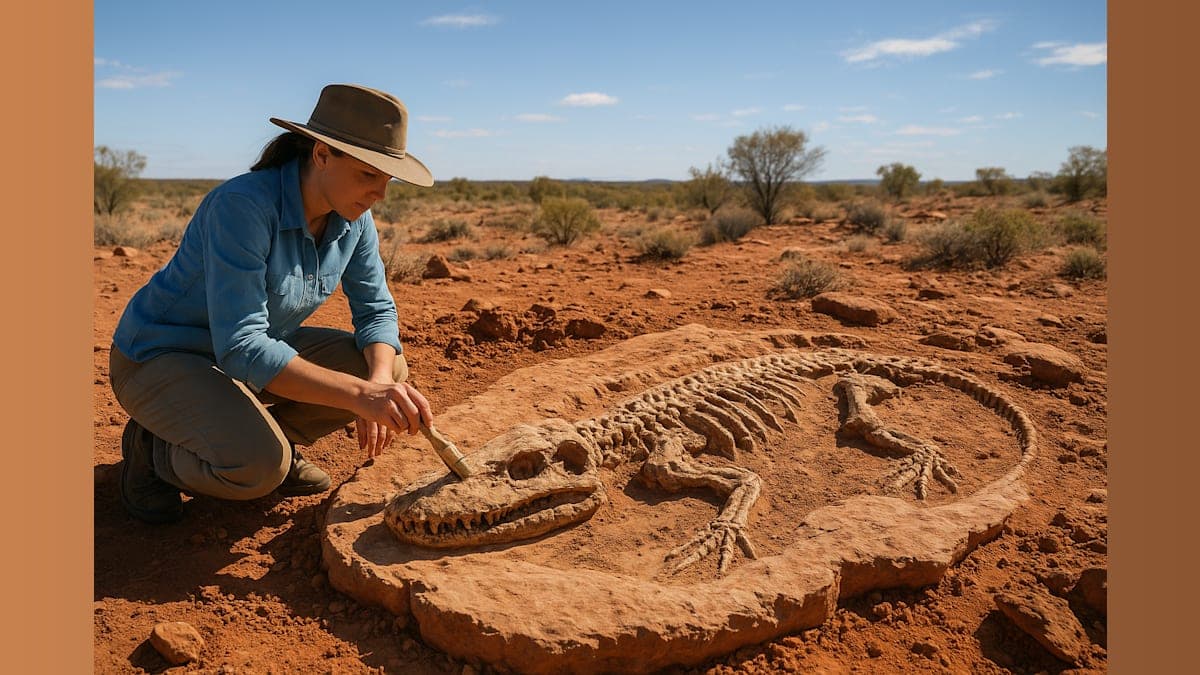
In a remarkable tale of scientific fortune, paleontologists have reunited long-forgotten fossils with their homeland, uncovering the story of an ancient marine predator that once roamed prehistoric waters across vast distances.
The fossils in question belong to Aphaneramma, a formidable amphibian that lived approximately 250 million years ago. According to researchers, this creature undertook an extraordinary migration from the region that would become the Norwegian Arctic to the western coast of what is now Australia. The discovery has provided Australian scientists with valuable opportunities to refine their understanding of these ancient marine amphibians and their evolutionary lineage.
A Predator of Prehistoric Proportions
Lachlan Hart, a lecturer in paleontology at the University of New South Wales, described the creature as a fearsome aquatic hunter. The animal possessed distinctive physical characteristics that made it a dominant predator in ancient marine ecosystems.
According to Hart, the Aphaneramma featured a crocodile-like skull structure combined with a body resembling that of a giant salamander, complete with notably sharp teeth. These anatomical features indicate that the creature functioned as an active and efficient predator in aquatic environments.
From Outback Discovery to Global Misidentification
The fossils were originally excavated in 1960 at Noonkanbah Station, located approximately 1,500 miles north of Perth in the Kimberley region. This area exemplifies the quintessential Australian Outback, characterized by resilient vegetation, distinctive red rock formations, and expansive scrubland terrain.
Initial analysis correctly identified the specimens as belonging to Temnospondyls, an important group of prehistoric amphibians. The fossils were designated under the name Erythrobatrachus. However, paleontologists at the time failed to recognize a critical detail: the collection actually contained remains from two distinct species that had been inadvertently combined.
This error might have been corrected through subsequent examination, but the specimens embarked on their own journey across continents. Various institutions worldwide received portions of the collection, and over time, the fossils were relegated to storage facilities where they languished in obscurity for five decades.
Serendipitous Reunion
The specimens eventually found their way to the United States, where they remained until researchers conducting routine collection assessments made an unexpected discovery. Upon examining the fossils, the American museum personnel learned that Hart and his colleagues were actively conducting research on precisely this type of specimen.
When contacted by the American researchers inquiring whether he had been searching for these particular fossils, Hart acknowledged that the rediscovery represented pure chance. He characterized the fortunate turn of events as a moment when researchers must genuinely assess their good fortune.
Survivors of Catastrophic Extinction
The significance of Temnospondyls extends beyond their impressive physical characteristics. Hart explained to ABC News Australia that these amphibians represent a critically important taxonomic group due to their remarkable resilience throughout Earth's history.
Temnospondyls survived two of the five major mass extinction events documented in the geological record. Most notably, they persisted through the Permian-Triassic extinction event, widely recognized as the most severe extinction crisis in Earth's history. This catastrophic event eliminated approximately 90 percent of all living organisms on the planet.
The rediscovery of these fossils and their proper identification provides researchers with enhanced understanding of how these resilient creatures adapted and survived through periods of extreme environmental upheaval. Such insights contribute valuable perspective on evolutionary resilience and adaptation strategies that allowed certain lineages to persist while countless others perished.
The reunion of these ancient specimens with Australian researchers demonstrates how paleontological discoveries can take circuitous paths before yielding their scientific secrets, and how chance encounters continue to advance our understanding of life's deep history.