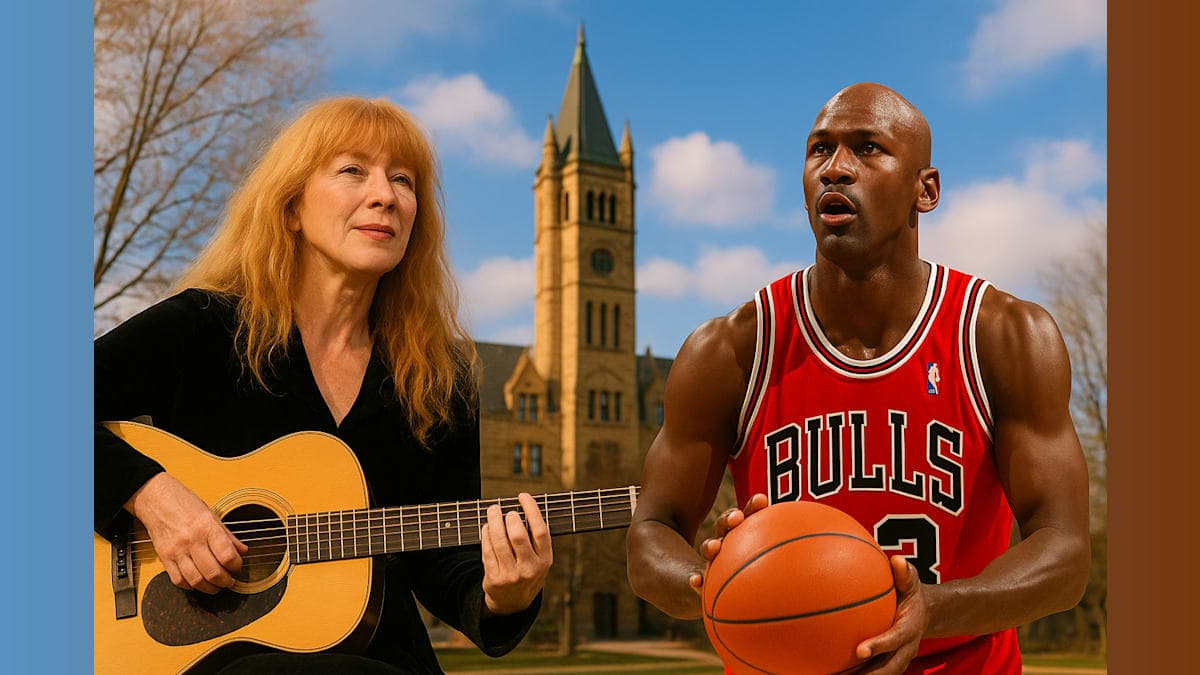
Throughout history, certain dates become intersections of extraordinary achievement and cultural significance. February 17 stands as one such day, marking the births of transformative artists and athletes while commemorating pivotal moments in humanitarian progress and artistic innovation.
Loreena McKennitt: A Voice That Transcends Borders
Canadian folk music virtuoso Loreena McKennitt celebrates her 69th birthday on this date. Born in Manitoba in 1957 to Irish-Scottish heritage, McKennitt discovered her calling after visiting Ireland, where Celtic musical traditions captivated her artistic sensibilities. Her journey from busking with a Celtic harp to finance her debut album to selling more than 14 million records worldwide exemplifies dedication to artistic vision.
McKennitt's creative process distinguishes her within the music industry. Before composing any album, she engages in extensive research, allowing historical and cultural exploration to inform her work. Her travels to Ireland inspired "Elemental" and "Parallel Dreams," while research in Spain's Galician region, with its Celtic and Arabic influences, shaped "The Mask and Mirror." This scholarly approach to music creation has earned her multiple platinum certifications in Canada and numerous industry honors.
The Birth of the International Red Cross
On February 17, 1863, five visionaries gathered in Geneva to establish what would become one of the world's most respected humanitarian organizations. Henry Dunant, Théodore Maunoir, Gustave Moynier, Louis Appia, and Guillaume-Henri Dufour founded the "International Committee for Relief of Wounded in the event of War," later renamed the International Committee of the Red Cross.
Their work led directly to the first Geneva Convention in 1864, establishing international standards for treating combatants and civilians during armed conflict. Twelve nations signed the initial convention, with representatives from major European powers recognizing the necessity of humanitarian principles in warfare. The movement expanded rapidly, with national societies forming across Europe and the American Red Cross established by Clara Barton in 1881. Henry Dunant received the inaugural Nobel Peace Prize in 1901 for this groundbreaking work.
Michael Jordan: Redefining Athletic Excellence
Basketball legend Michael Jordan was born on this date in 1963. The National Basketball Association recognizes him as the greatest basketball player of all time, a distinction supported by his extraordinary career statistics and achievements. Jordan led the Chicago Bulls to six NBA championships during the 1990s, demonstrating a combination of scoring ability, defensive prowess, and competitive intensity that transformed professional basketball.
Jordan's accomplishments extend beyond team success. He holds NBA records for career regular season scoring average at 30.12 points per game and playoff scoring average at 33.4 points per game. During the 1986-87 season, he became only the second player after Wilt Chamberlain to score 3,000 points in a season. His durability proved equally impressive, playing all 82 regular season games in nine of his 15 NBA seasons. Jordan's impact on the sport remains evident today, as NBA Finals television ratings have not returned to levels achieved during his final championship season.
Additional Historical Milestones
February 17 marks other significant cultural moments. In 1904, Giacomo Puccini's opera "Madama Butterfly" premiered, telling the tragic story of cross-cultural love and sacrifice. The Armory Show opened in New York City in 1913, introducing American audiences to European impressionist art. The Phantom, recognized as the world's first comic superhero, was published in 1936.
Acclaimed actor Hal Holbrook was born on this date in 1925. He achieved international recognition for his one-man show portraying Mark Twain, earning a Tony Award in 1966. His film career included memorable roles in "All the President's Men," where he portrayed Deep Throat, and "Into the Wild," which earned him Academy Award and Screen Actors Guild nominations at age 82.
Green Day co-founder Billie Joe Armstrong celebrates his 54th birthday on February 17. Born in 1972, Armstrong wrote his first song at age five and met his future bandmate in elementary school. Their collaboration produced "American Idiot," an anti-war album that won a Grammy Award and achieved massive commercial success.
Finally, on this date in 1996, Russian chess Grandmaster Garry Kasparov completed his victory over IBM's supercomputer Deep Blue in a six-game match. Kasparov, who became World Chess Champion at age 22 in 1985, held the title for 15 years and ranked as the world's number one player for 255 months. Beyond chess, he has become an outspoken advocate for democracy and human rights, founding the Renew Democracy Initiative in 2017.
These anniversaries remind us that individual dedication, whether to artistic excellence, humanitarian service, athletic achievement, or democratic principles, creates lasting impact that transcends generations. February 17 serves as a testament to human potential across diverse fields of endeavor.