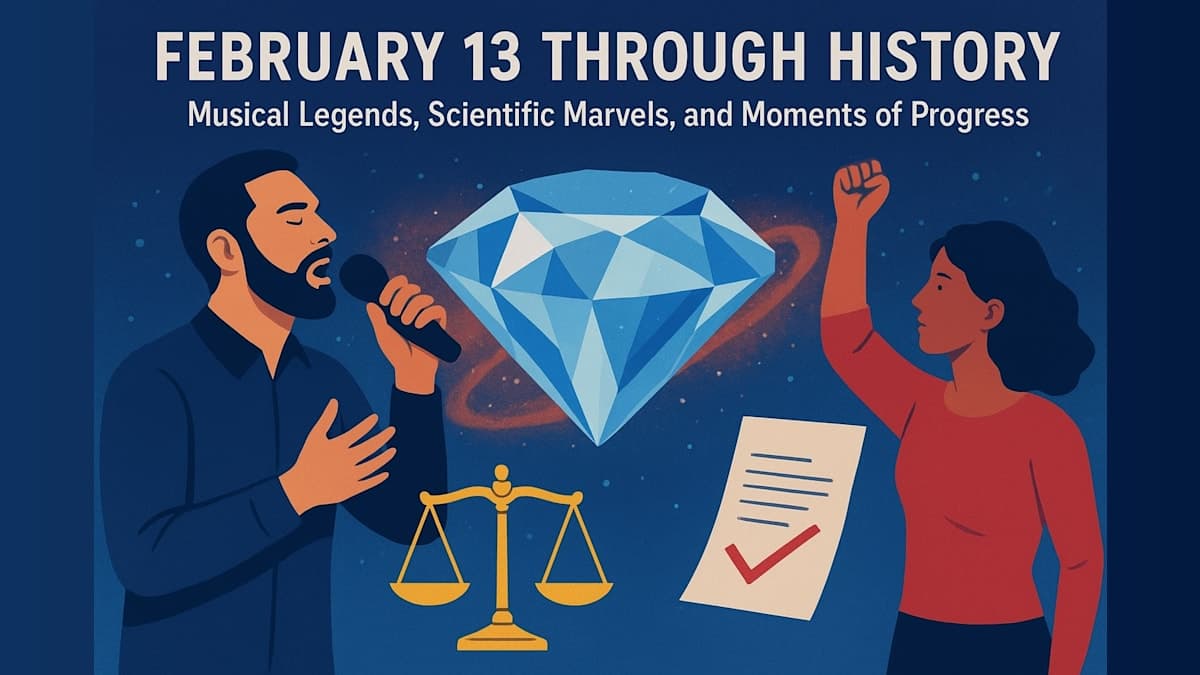
February 13 stands as a remarkable date in history, marked by groundbreaking achievements across multiple disciplines. From musical innovation to astronomical discoveries, this day has consistently delivered moments worth celebrating.
Musical Innovation Takes Center Stage
Peter Gabriel, born on this date in 1950, fundamentally transformed the relationship between music and visual media. The English singer-songwriter, who founded Genesis at seventeen, achieved solo success that extended far beyond conventional measures. His 1986 single "Sledgehammer" earned a record nine MTV Awards, with its pioneering stop-motion claymation video becoming the most-played music video in history. This achievement opened unprecedented creative pathways for artists seeking to distinguish their work through compelling visual narratives.
The album "So," which featured "Sledgehammer," achieved five-times platinum certification and included numerous critically acclaimed tracks. Beyond commercial success, Gabriel demonstrated sustained commitment to social justice, particularly through anti-apartheid activism. In 2007, he co-founded The Elders with Richard Branson, establishing an organization of distinguished global leaders launched alongside Nelson Mandela and Desmond Tutu.
The date also marks a pivotal moment in rock history. In 1973, Eric Clapton returned to public performance at London's Rainbow Theatre following two years of heroin-induced isolation. Organized by Pete Townshend, the concert featured performances alongside Ronnie Wood and Stevie Winwood. The recorded album documented Clapton's comeback, preceding his recovery and subsequent recording of the acclaimed "461 Ocean Boulevard."
Scientific Discovery Reaches Cosmic Proportions
In 2004, astronomers announced an extraordinary discovery: the largest known diamond in the universe. Measuring 2,300 miles in diameter and containing ten billion trillion trillion carats, this celestial wonder represents the crystallized remnant of a white dwarf star in the Centaurus constellation. Scientists nicknamed it Lucy, referencing the Beatles composition "Lucy in the Sky with Diamonds."
The discovery illuminated fundamental processes of stellar evolution. When white dwarf stars of this particular classification cool, their constituent materials—primarily carbon and oxygen—undergo crystallization, producing diamond-like structures. While terrestrial diamonds remain small and rare, galactic conditions can generate diamond formations on scales that challenge human comprehension.
Earlier in 1967, Dr. Jules Piccus from the University of Massachusetts made another significant discovery at the Spanish National Library: two previously unknown manuscripts by Leonardo da Vinci. The Madrid Codices, containing 197 pages bound in red leather, had remained unidentified for 252 years. UNESCO later described these works as capturing da Vinci at his most creative, addressing engineering challenges with principles and techniques remarkably advanced for the fifteenth century.
Milestones in Rights and Recognition
February 13 has witnessed significant advances in human rights and social justice. In 2012, Washington became the seventh United States jurisdiction to legalize same-sex marriage, marking substantial progress in marriage equality. Four years earlier, Australian Prime Minister Kevin Rudd delivered a historic apology to Indigenous Australians and the Stolen Generations, acknowledging past injustices.
In 2011, the Umatilla American Indian nation secured the right to hunt bison in Montana, restoring a tradition guaranteed by an 1855 treaty with the federal government. This victory concluded more than a century of restricted access to traditional hunting grounds, affirming treaty obligations long ignored.
The date also commemorates earlier achievements in equality and creative expression. In 1881, Hubertine Auclert published the first edition of La Citoyenne, a feminist newspaper that operated for ten years in Paris. In 1914, the American Society of Composers, Authors and Publishers was established to protect musical copyrights, providing essential safeguards for creative professionals.
Additional Historical Significance
The historical record for February 13 extends across centuries. In 1635, Boston Latin School became the first public educational institution in what would become the United States; Benjamin Franklin later became its most notable student who did not complete his studies there. Spain recognized Portuguese independence in 1668, resolving decades of territorial conflict.
In 1937, Canadian illustrator Hal Foster published the first Prince Valiant comic strip, which he would continue creating for forty-two years. The work distinguished itself through exceptional medieval detail, functioning as what Foster described as an illustrated historical novel.
More recently, in 2007, approximately 1,500 volunteers assembled in New Orleans for a coordinated effort to construct playgrounds for nearly 36,000 children. This initiative occurred two years after Hurricane Katrina devastated the region, with playground designs created by students themselves.
February 13 continues to represent human achievement across diverse fields, demonstrating how individual creativity, scientific inquiry, and collective action shape progress. These historical moments remind us that significant advances often emerge from sustained dedication to excellence and justice.