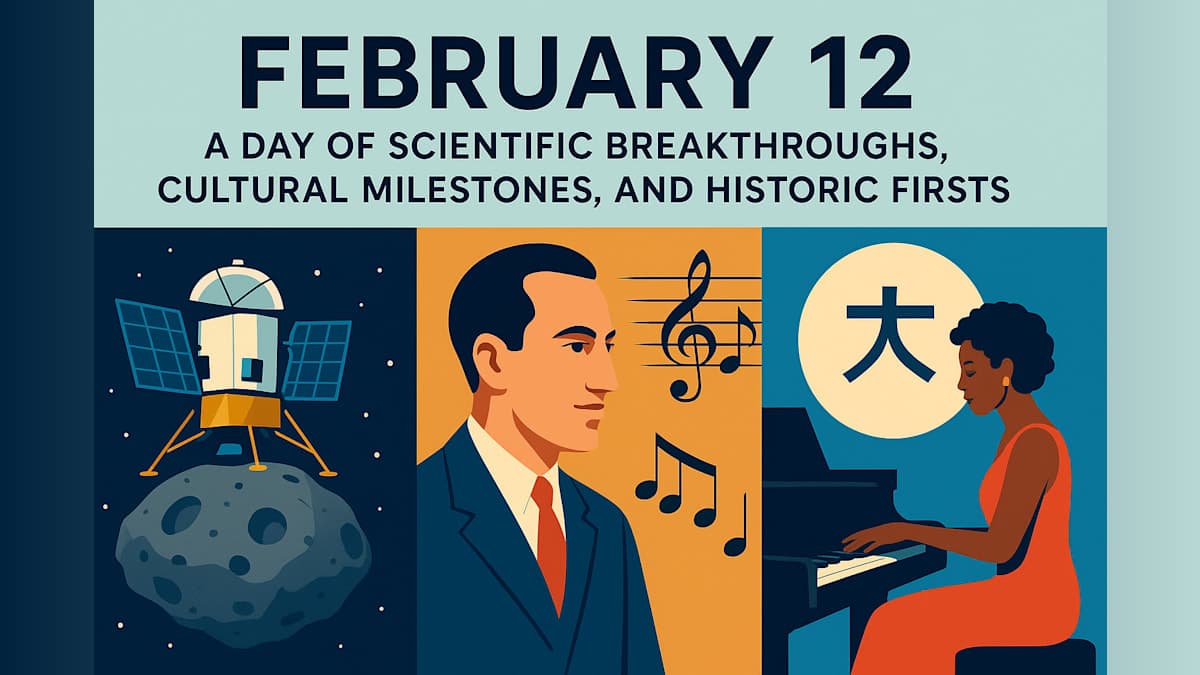
February 12 stands as a remarkable date in human history, marked by achievements spanning space exploration, musical innovation, and social progress. This date has repeatedly demonstrated humanity's capacity for scientific discovery and cultural advancement across multiple centuries.
Historic Space Exploration Achievement
Twenty-five years ago on this date, the Near Earth Asteroid Rendezvous (NEAR) Shoemaker spacecraft accomplished an unprecedented feat in space exploration by successfully landing on asteroid Eros 433. This mission represented the first time humanity had achieved both orbit and landing on an asteroid, marking a significant milestone in our understanding of near-Earth objects.
The technical complexity of this achievement cannot be overstated. The spacecraft needed to precisely track the asteroid's heliocentric orbit around Earth while matching its trajectory and speed to insert itself into the weak gravitational field. Mission controllers confirmed that Eros possessed no moons, allowing the spacecraft greater flexibility in its approach path. During the critical descent phase, the craft decelerated from 19.3 meters per second to merely 8 meters per second through reverse thrust maneuvers.
The scientific returns from this mission exceeded all expectations. NEAR Shoemaker orbited the 13 by 33-kilometer asteroid for an entire year before landing in February 2001. The mission revealed that the 4.5 billion-year-old asteroid exhibited lower density than scientists had predicted and lacked a magnetic field. The spacecraft's near-infrared spectrometer mapped more than 70 percent of the surface, providing crucial data about the asteroid's interior composition. Ultimately, the mission returned approximately ten times more data than originally anticipated, including 160,000 images that continue to inform planetary science research.
Musical Innovation and American Identity
One hundred and two years ago on February 12, 1924, George Gershwin premiered his groundbreaking composition Rhapsody in Blue in New York City. This nine-minute piece revolutionized American music by seamlessly blending classical composition with modern jazz elements, creating a work that would become one of the most recognizable pieces in the American concert repertoire.
The 26-year-old Gershwin composed the entire piece during a train journey to Boston, finding inspiration in the rhythmic sounds of rail travel. He later described his creative process, noting that he heard music within the noise of the train's movements and envisioned the complete structure of the rhapsody as a musical representation of American diversity and energy.
The premiere concert, titled An Experiment in Modern Music and commissioned by conductor Paul Whiteman, attracted an audience of influential musicians including Rachmaninoff, Stravinsky, Stokowski, and John Philip Sousa. Despite a malfunctioning ventilation system that tested audience patience, the opening clarinet glissando of Rhapsody in Blue captivated listeners. Renowned composer Leonard Bernstein later praised Gershwin's work in 1955, declaring that no melodist since Tchaikovsky had demonstrated such inspired composition.
Advancing Women's Rights in America
One hundred and fifty-six years ago, February 12, 1870, marked a pivotal moment in American women's suffrage when the Utah Territory granted women the right to vote. Two days following this legislative action, Seraph Young became the first American woman to cast a ballot under equal suffrage laws, participating in a municipal election alongside two dozen other Utah women over the age of 21.
This achievement occurred decades before Utah achieved statehood and attracted national attention from suffrage movement leaders. Susan B. Anthony and Elizabeth Cady Stanton visited Utah one year later to observe this pioneering suffrage experiment, recognizing its significance for the broader national movement for women's voting rights.
Additional Historical Milestones
February 12 also commemorates the birth of several influential figures who shaped their respective fields. In 1809, both Charles Darwin, whose theory of natural selection revolutionized biological science, and Abraham Lincoln, the 16th President of the United States, were born. Darwin's observations of finch adaptations in the Galapagos Islands would later inform his groundbreaking work, The Origin of Species.
The date holds significance for Latin American independence as well. In 1817, colonial Chile declared independence from Spain following the Battle of Chacabuco, where Argentine General Jose de San Martin and Chilean leader Bernardo O'Higgins led the Army of the Andes to victory against royalist forces.
In 1909, the National Association for the Advancement of Colored People (NAACP) was founded, establishing an organization that would become instrumental in advancing civil rights throughout the 20th century and beyond.
These diverse achievements demonstrate how February 12 has consistently witnessed moments of human progress across scientific, cultural, and social domains. From exploring celestial bodies to expanding democratic participation, this date serves as a reminder of humanity's ongoing capacity for innovation and advancement.