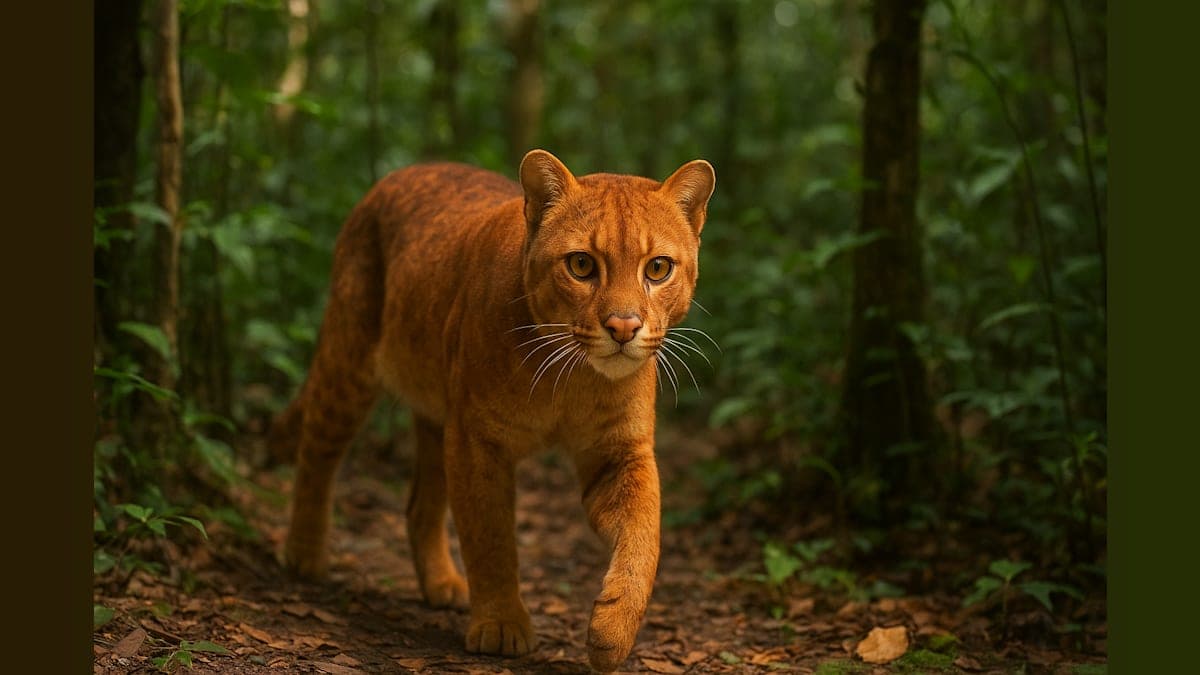
Wildlife conservationists in Thailand have achieved a remarkable documentation of one of the world's most elusive feline species. Camera trap technology at Khao Luang National Park in northern Thailand successfully recorded footage of an Asian golden cat, a creature steeped in mythological significance and scientific mystery.
The Asian golden cat, scientifically designated as Catopuma temminckii, represents one of the most challenging wildlife species to observe in natural habitats. Park officials announced the sighting through social media on July 7th, sharing footage that captured the animal for a mere 10 seconds before it vanished into the forest understory.
The Mythological Significance of the Fire Tiger
Thai folklore has long celebrated this enigmatic feline as the "fire tiger," a name derived from its distinctive coat coloration that shifts between tan and vibrant orange hues depending on lighting conditions and individual variation. The nomenclature reflects deep cultural connections to the species, though interestingly, Chinese tradition refers to the same animal as the "metal cat," demonstrating the diverse cultural interpretations of this rare predator.
Among the Karen people of southeastern Myanmar, the species holds particular spiritual significance. Traditional beliefs maintain that possessing even a single hair from the golden cat provides protection against tiger attacks, illustrating the reverence and mystique surrounding this seldom-seen creature.
Evolutionary Heritage and Biological Characteristics
Despite its common name referencing tigers, the Asian golden cat diverged from its shared evolutionary lineage with true tigers between 8 and 16 million years ago. The species demonstrates closer genetic relationships to the bay cat of Borneo and the marbled cat found in Himalayan regions, representing a distinct branch of the feline family tree.
The behavioral adaptations of Catopuma temminckii have proven exceptionally effective for survival while simultaneously making scientific study extraordinarily difficult. These cats maintain territorial, solitary lifestyles and possess the remarkable ability to hunt during both diurnal and nocturnal periods. The absence of predictable behavioral patterns or social structures renders the species one of the most challenging wildcats for researchers to monitor and study.
Conservation Status and Population Uncertainty
The International Union for Conservation of Nature has classified the Asian golden cat as Vulnerable, placing it in the same threat category as the cheetah. The species confronts the standard array of conservation challenges facing large predators: habitat destruction and fragmentation, illegal poaching activities, and human-wildlife conflict centered on livestock predation.
Population estimates published in 2023 by the IUCN reveal the profound uncertainty surrounding this species. Scientists suggest that mature individuals across the entire geographic range could reasonably number approximately 7,000 animals. However, the estimate includes a staggering variance, with potential populations ranging from as few as 1,000 to as many as 12,000 individuals. This wide margin reflects the fundamental challenge of studying an animal that has evolved to remain virtually invisible to human observation.
Notably, the estimated population exceeds those of several more famous endangered cats, including tigers, snow leopards, and cheetahs, suggesting that the Asian golden cat may be more resilient than previously understood, despite its rarity in documented sightings.
Geographic Distribution and Stronghold Habitats
Current research identifies several critical stronghold regions where Asian golden cat populations appear relatively stable. These areas include Bhutan, the border regions of western Myanmar and eastern Bangladesh, Thailand's western coastal forests, the forested highlands of central Malaysia, and the southern slopes of Sumatra. The Khao Luang National Park sighting confirms the continued presence of the species in Thai protected areas, validating conservation efforts in the region.
The Importance of Camera Trap Technology
The successful documentation at Khao Luang National Park underscores the critical role of camera trap technology in modern wildlife conservation. These motion-activated devices provide researchers with invaluable data about species presence, distribution, and behavior without requiring direct human presence that might disturb sensitive wildlife populations. For exceptionally elusive species such as the Asian golden cat, camera traps often represent the only practical method of confirming population persistence in protected areas.
The enthusiasm expressed by Thai conservation officials regarding this brief footage demonstrates the significance of every documented encounter with this legendary feline. Each sighting contributes essential data points to the limited scientific knowledge base, helping researchers better understand habitat requirements, range boundaries, and conservation priorities for protecting the fire tiger and its forest home for future generations.