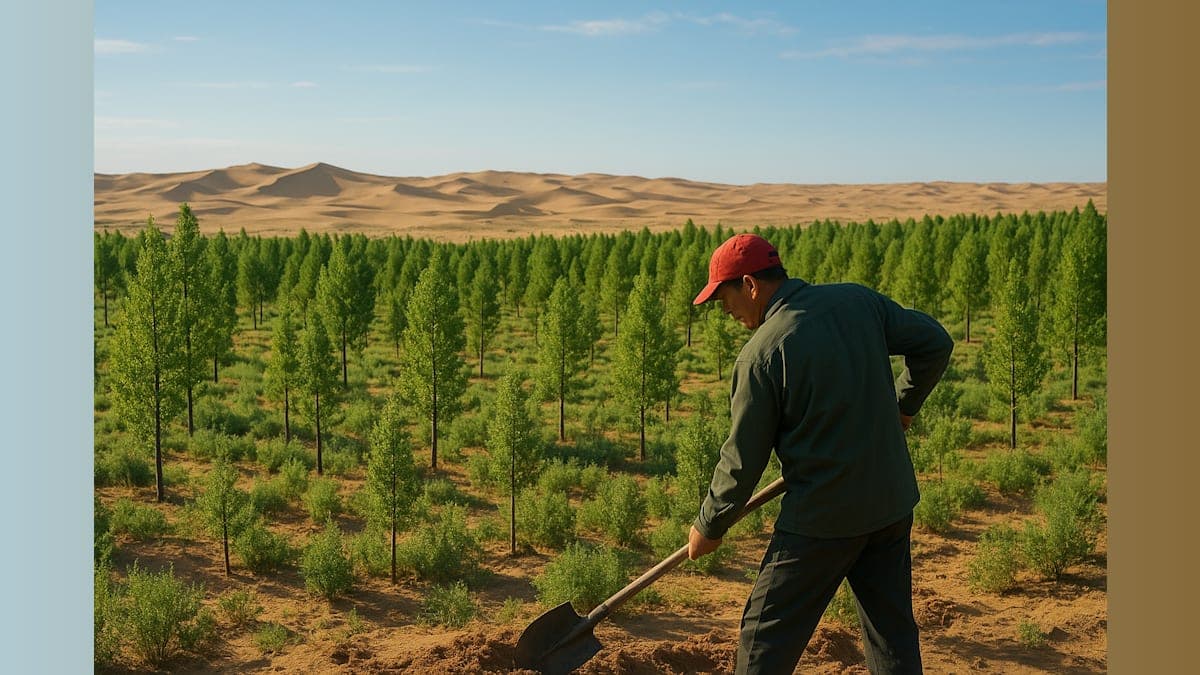
A groundbreaking environmental restoration project in China has demonstrated that even the most inhospitable landscapes can be transformed into effective tools for combating climate change. Over the course of more than 40 years, Chinese authorities have successfully planted billions of trees around the Taklamakan Desert, creating what has become known as the "Green Great Wall" and establishing a significant carbon sink in an area previously incapable of absorbing atmospheric carbon dioxide.
The Three-North Shelter Belt program, which commenced in 1978 and concluded in 2024, initially aimed to protect agricultural lands and grasslands from encroaching desert sands. However, recent scientific analysis has revealed an additional benefit of substantial global importance: the massive reforestation effort has created a carbon sink that actively reduces atmospheric CO2 concentrations in the region.
Scientific Validation of Carbon Sequestration
Research conducted by NASA in collaboration with the California Institute of Technology has utilized satellite data to quantify the environmental impact of this unprecedented reforestation initiative. The findings, which represent the first scientific confirmation that human intervention can enhance carbon sequestration in extreme arid environments, carry significant implications for global climate strategy.
Professor Yuk Yung, a planetary science expert at Caltech and senior research scientist at NASA's Jet Propulsion Laboratory, emphasized the breakthrough nature of these findings. The research documented that the project has reduced average carbon content in the desert atmosphere from 416 parts per million to 413 parts per million, a measurable decrease in a region where such reductions were previously considered impossible.
The Challenge of the Taklamakan Desert
The Taklamakan Desert presents one of the most formidable environments on the planet for vegetation growth. Historically referred to as the "sea of death," this vast expanse represents the single point on Earth most distant from any ocean. Surrounded by imposing mountain ranges including the Himalayas, the Pamirs, the Tian Shan, and the Altai, the desert remains almost completely isolated from moisture sources, creating conditions of extreme aridity.
Despite these harsh conditions, an estimated 66 billion trees have been planted since the program's inception. This massive increase in vegetation has generated cascading environmental benefits, including a measurable increase in average regional rainfall. The additional precipitation has, in turn, stimulated natural foliage growth during wet seasons, further enhancing the photosynthetic capacity of the region and amplifying carbon sequestration effects.
Global Implications for Climate Strategy
The success of the Green Great Wall project carries substantial implications for global climate mitigation efforts. Deserts currently cover approximately one-third of the planet's land surface, yet these vast areas collectively contain less than one-tenth of the world's terrestrial carbon stock. The transformation of even a fraction of these landscapes into carbon-absorbing ecosystems could significantly impact atmospheric CO2 levels.
Current atmospheric CO2 concentrations stand at 429.3 parts per million globally, a substantial increase from pre-industrial levels of 350 parts per million. While tree planting initiatives face limitations when considered at a planetary scale—there exists a finite amount of land suitable for conversion to forest—the Chinese project demonstrates that previously dismissed desert regions may offer untapped potential for carbon sequestration.
The research findings suggest that shelter belt-style reforestation programs could be replicated in other desert regions worldwide, potentially opening vast new areas for carbon absorption. In their natural state, deserts possess minimal capacity for carbon sequestration due to sparse or absent vegetation. However, the Taklamakan project proves that strategic human intervention can fundamentally alter these dynamics.
Long-Term Environmental Transformation
The multi-decade timeline of the Three-North Shelter Belt program underscores both the scale of commitment required for such transformative environmental projects and the tangible results that sustained effort can achieve. The project successfully accomplished its original objective of halting desertification and protecting adjacent agricultural lands from sandstorms, while simultaneously creating an unexpected climate benefit of global significance.
As the international community continues to seek effective strategies for addressing climate change, the Chinese reforestation initiative offers empirical evidence that large-scale ecological restoration can yield measurable atmospheric improvements. The project demonstrates that with sufficient planning, resources, and time, even the most challenging environments can be enlisted in the effort to mitigate greenhouse gas concentrations and combat global temperature increases.